The Current: 2026 news from the CWRU campus
News from the CWRU Campus
AWARDS
Partnership to propel manufacturing innovation
In July, the U.S. National Science Foundation (NSF) selected NEOSMART—a coalition of more than 70 partners convened and led by Case Western Reserve University— for its Regional Innovation Engines program. As one of just 12 NSF Engines chosen in this round of funding, NEO-SMART could bring up to $160 million in federal investment to Northeast Ohio, making it and the entire state a national hub for manufacturing innovation, technology and jobs.

NEO-SMART represents industry, civic and philanthropic organizations, higher education, and state and local government. Its work could benefit from CWRU’s new Roger E. Susi Interdisciplinary Research Building, which includes a focus on advanced manufacturing and materials. (Read more about the building)
“The manufacturing challenges of the next decade will be solved by academic researchers, industry partners and factory floor teams who work in collaboration to turn scientific insight into commercial reality,” said CWRU President Eric W. Kaler, the Morton L. Mandel Presidential Chair. “We are tremendously grateful for the extraordinary support and advocacy we received from federal, state and local elected officials that led to this funding opportunity.”
COMMUNITY
Student-run clinic helps patients find a path forward
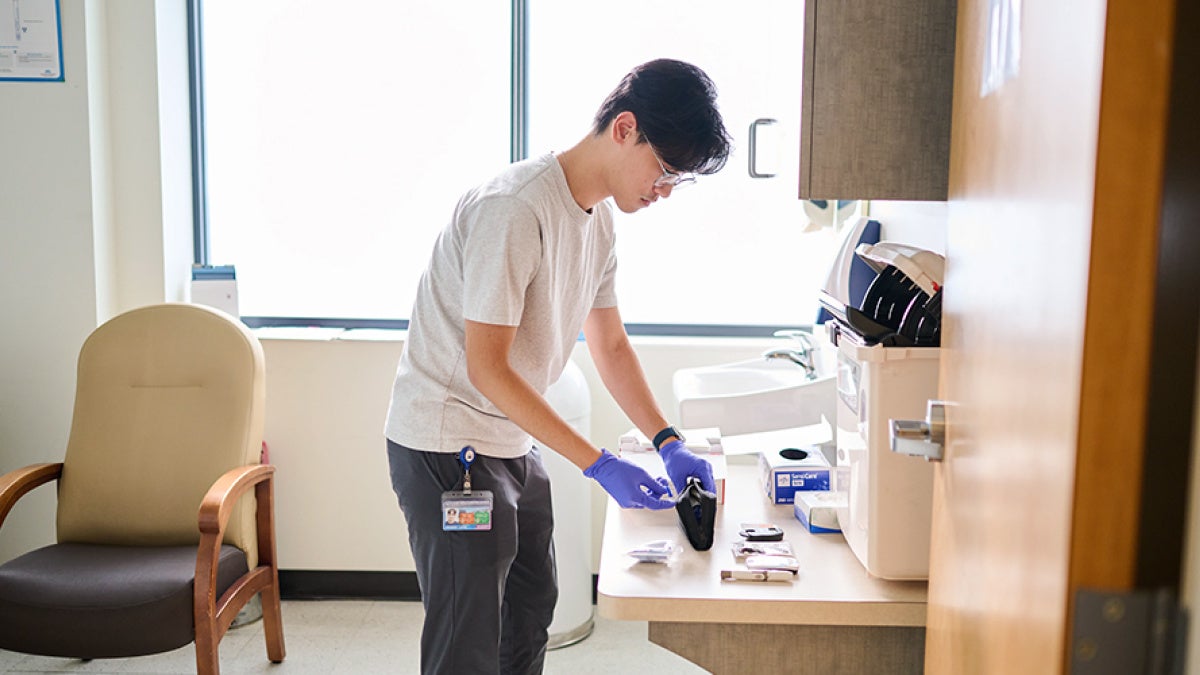
At Horizons Community Clinic, care might begin with an immediate need for treatment, but the impact extends far beyond the appointment—for the patients it serves and the medical students who run it.
Open twice a month to anyone in the greater Cleveland community— especially people without health insurance—the clinic provides free healthcare services performed by MD students at CWRU School of Medicine.
But student volunteers go further, spending an hour or more with patients to complete online applications for Medicaid or other benefits to help them gain coverage—and a path to ongoing care and a better quality of life.
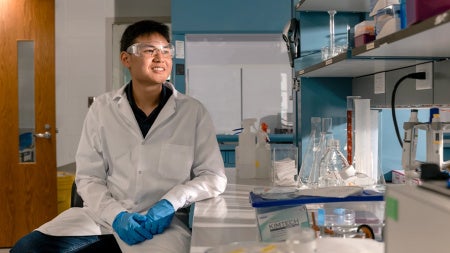
“Our mission with Horizons is to help patients establish longitudinal care,” said Andrew Liang, a second-year medical student and the clinic’s co-director this academic year. “And the first way to do that is to get patients insured so they can be seeing providers.”
Launched last fall in an existing clinic space near downtown Cleveland, Horizons is open on Monday nights and run by medical students under the supervision of attending physicians. They’ve helped patients with issues ranging from uncontrolled hypertension and diabetes to sore throats and ankle pain. They even helped develop a pathway for a patient who needed a liver transplant.
In the process, they are learning how to practice medicine, how healthcare systems work—and how daunting they can be. They’ve also learned about the importance of talking with patients about their lives and struggles. Some lack insurance or money to pay for prescriptions.
“Without an understanding of a patient’s social background, it makes it really hard to treat their diseases effectively,” said Shailee Shroff, the clinic’s other director and a second-year student. “We’re trying to work with patients to make decisions that are best for them in the circumstances they’re in.”
Visit Horizons Community Clinic to learn more.
DEVICES
Academic-industrial partnership to develop rapid oral cancer test
A CWRU-led research team is developing a noninvasive oral cancer test to help clinicians decide within minutes whether a suspicious lesion in the mouth needs a biopsy.
The test will help in higher-income countries where lesions are often tested, even though roughly 90% are benign, and in less prosperous countries where diagnostic services are more limited.
The project joins a discovery made in the university’s School of Dental Medicine with device-engineering and microfabrication expertise from Case School of Engineering and the commercialization capabilities of industry partner Hemex Health Inc. of Portland, Oregon.
The work is supported by a new five-year, $2.93 million grant from the National Institutes of Health’s National Cancer Institute (NCI) that teams university researchers with a company to advance technology from the lab to a commercial, point-of-care product.
"Our goal is to take a sophisticated laboratory measurement and engineer it into a simple, affordable device that works reliably at the chairside,'" said Aaron Weinberg, DMD, PhD, who made the discovery leading to the test and is a professor and chair of the Department of Biological Sciences at the dental school and a member of the NCI-designated Case Comprehensive Cancer Center.
The other principal investigators are: Umut Gurkan, PhD, the Wilbert J. Austin Professor of Engineering in the Department of Mechanical and Aerospace Engineering, and Peter Galen (CIT '76), chief innovation officer and co-founder of Hemex Health, whose Gazelle rapid, point-of-care device, developed with CWRU, has been used in more than 40 countries for blood-disease testing.
Research reported in this story is supported by the NCI of the NIH under Award Number R01CA306044. The content is solely the responsibility of the authors and does not necessarily represent the official views of the NIH.
Hero image photograph of Andrew Liang by Jeani Brechbill.