Anirban Sen Gupta, PhD, is a quintessential Case Western Reserve University researcher. He’s tackling critical national and global issues, pursuing creative solutions and translating them into real-world applications.
During the last 20 years, the biomedical engineer and his team have made fundamental discoveries for managing bleeding and clotting dysfunctions supported with federal grants, created the startup Haima Therapeutics, and are developing synthetic platelets that could represent a vital advance in trauma medicine for hemorrhaging patients, inside or outside of hospitals, and wounded soldiers on battlefields.
Sen Gupta has found significant success in his longtime lab in CWRU’s Wickenden Building and worked with other researchers in his field nationally and internationally. Yet, he can’t wait to move—the Wallace R. Persons Professor is one of dozens of faculty members establishing new labs in CWRU’s Roger E. Susi Interdisciplinary Research Building, which opened in October.
He’s excited about the building’s potential to unite people from different disciplines, experiences and philosophies and wants to be part of a space where meetings across fields—whether in planned sessions or serendipitous hallway meet-ups—spur new ideas, projects and research teams.
“We have very successfully collaborated inside and outside of CWRU—but mostly within our own research field,” Sen Gupta said. “But [the Susi Building] will now provide the opportunity to expand our research endeavors across multiple disciplines, opening new doors for life-saving translational technologies.”
And that’s exactly the point.
Located on the Case Quad, the $300 million project—the university’s largest single investment ever in research—brings 65 faculty members, 300 researchers, dozens of students and a range of off-campus partners together to collectively act on some of the world’s most complex scientific and engineering problems to benefit people and communities. In the process, it will also give students the opportunity to join major projects, strengthening the pipeline of future researchers. In addition, the Susi Building’s shared state-of-the-art instruments and equipment—available to outside users and spread across about 11,000 square feet of “core facilities” space—are expected to greatly expand the types of studies researchers can conduct and bolster their grant applications.
Moreover, by housing multidisciplinary projects and advanced equipment under one roof, CWRU aims to deepen community and industry partnerships, while spurring new ones. The benefit of such collaborations that cross not only disciplines but sectors—and bring together experts from academia, industry, philanthropy and government—is already apparent. In July, a partnership of 70+ area organizations convened and led by CWRU—known as NEO-SMART—won a prestigious U.S. National Science Foundation award of up to $160 million. Working to make Northeast Ohio a national innovation hub for advanced materials and manufacturing, the partnership and the Susi Building could benefit from each other’s work and success.
The building also underscores two other essential university commitments: integrating humanities, arts and STEM (science, technology, engineering and mathematics), and expanding community engagement. The building has dedicated space for that integration and the new Tinkham Veale Gateway connects the Case Quad to the neighborhood.
The building’s primary focus—providing a top-notch environment for interdisciplinary work—involves a broad range of researchers mainly from the College of Arts and Sciences, Case School of Engineering and the School of Medicine.
“We already have tremendous strengths,” said Michael Oakes, PhD, CWRU’s executive vice president for research and economic development. “What this building is designed to do is bring those strengths into closer contact—not just physically, but intellectually—so that researchers are looking beyond their field to ask: ‘What is the problem? Who else can help solve it? And what do we need to build around it?’”
Clustered for solutions
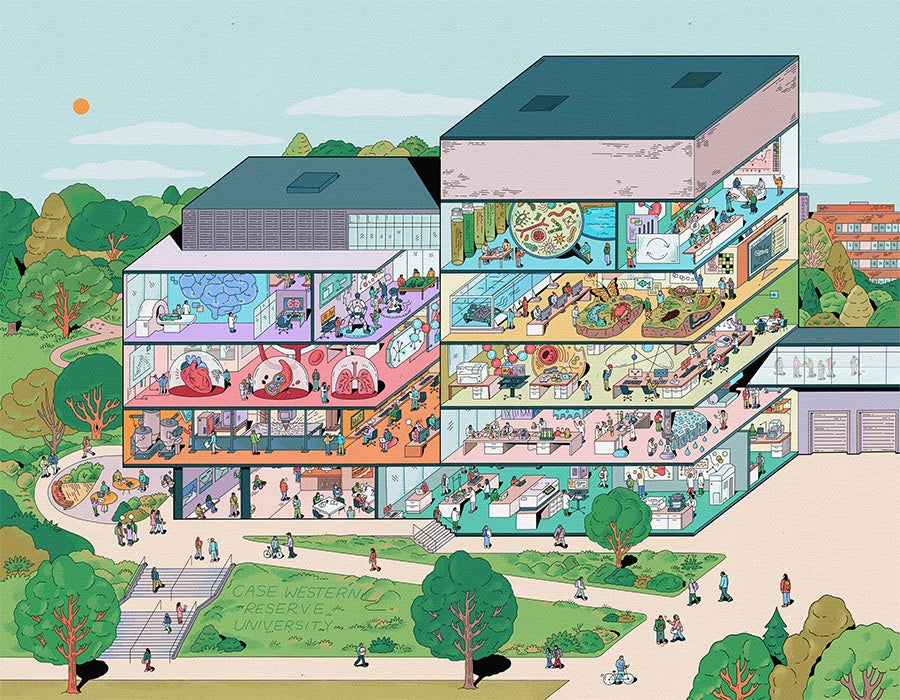
The five-story, 189,000-square-foot Susi Building is organized around seven research clusters: James M. Galm, PhD, PE Electrochemical Engineering & Energy Science, Advanced Materials & Manufacturing; Molecular Therapeutics; Precision Diagnostics & Therapeutics; NeuroTechnology; NeuroRobotics; and Climate & Ecosystem Science.


Oakes said each cluster needed a set of problems robust enough for interdisciplinary researchers to work together and feed off one another’s projects, while not so large that no one could address them.
Sen Gupta, for example, leads the Precision Diagnostics & Therapeutics cluster, which aims to develop innovative approaches for assessing, monitoring and treating human diseases through personalized strategies rather than one-size-fits-all solutions.
Each cluster will cover roughly half a floor, with pairs of clusters whose work could easily align located on the same floor. For instance, the two therapeutics clusters are on the second floor.
Some floors will also house elements to help drive discovery and innovation. The ground floor is dedicated to the primary shared core research services and equipment space, while additional core facilities are housed within related clusters. The first floor will house not only two clusters but a new partnership with Google, providing researchers with advanced artificial-intelligence tools and expertise to propel their work even further.
The third floor, the Eric & Jane Nord Family Floor, features collaboration space for CWRU’s Baker-Nord Institute for the Humanities and includes the new Jack, Joseph and Morton Mandel Experimental Humanities Hub, an interactive area for humanities, arts and technology. (Read in the magazine about other innovative CWRU humanities initiatives.)
Calibrated for collaboration
Each cluster of researchers arrives at the building with existing collaborations across areas of expertise among members working around shared questions. The building provides a space to deepen those relationships, amplify the work and explore the next problems together.
Consider the Climate & Ecosystem Science cluster, which studies how a changing world affects its inhabitants—humans, animals, organisms, viruses—and how they, in turn, shape it.
Leading the cluster is Sarah Bagby, PhD, an associate professor of biology, whose recent work involves analyzing a thawing permafrost in Sweden that is releasing increasing amounts of carbon—primarily in the form of methane gas—and seeking to mitigate the ecological changes driving methane’s release.
In assembling faculty for the cluster, Bagby sought members from the college and engineering school with complementary experimental methods whose research areas touched but differed.
For instance, two of the cluster’s members have experience studying algal blooms. One works to identify and understand toxins that harmful algal blooms transmit through waterways and explore potential ways to intervene using chemical agents; the other focuses on forecasting and mitigating such blooms in natural lakes.
The three others study human and environmental health from other perspectives: developing methods to detect and monitor air quality in Cleveland, studying microbiology to protect human and environmental health, and using geological records to reconstruct the history of Earth’s CO2 levels and understand periods of warming.
“I want people whose questions are interesting to each other but who tend to look at their systems from different perspectives, so that we can each sort of say: ‘Oh, that’s really cool. If it were my work, I would approach it this way. Could that give you a new angle here?,’” Bagby said, “so we can try to collectively level up the ways that we’re able to pursue these questions.”
Bagby’s team may be asked to team up on unexpected collaborations, too. Drew Adams, PhD, who leads the Molecular Therapeutics cluster, for example, wants to reach out. His cluster includes investigators who identify new small molecules as starting points for future therapies—and he sees possible opportunities to work with researchers who study small molecules in the soil and Lake Erie.
“We think about small molecules differently, but a lot of the same tools and instruments can be used to do that, and so I think [the Susi Building will] be an interesting experiment, just bringing people and their toys together to see what impactful work can be done,” said Adams, an associate professor who holds the Thomas F. Peterson Professorship in Cancer and Energy Research.
The advances that emerge from these clusters and others are expected to have impacts not only across the globe, but in northeast Ohio, spurring economic growth and creating jobs.
One area primed for such powerhouse potential is the Susi Building’s first floor, home to both the Advanced Materials & Manufacturing and the Galm Electrochemical Engineering & Energy Science research clusters, which aim to develop advanced materials, explore innovative technologies and test new manufacturing processes. Here, campus researchers and their partners from industry, startups and elsewhere can work together—using the building’s sophisticated labs and equipment to contribute to the NEO-SMART Engine program and the region’s future success in science, engineering and economic development.
The opening of the Susi Building within months of that NSF award reflects years of work in service of President and Morton L. Mandel Presidential Chair Eric W. Kaler’s mission to ensure CWRU has increased its impact on northeast Ohio’s prosperity and well-being, Oakes said.
“We built the [Susi Building] and convened what became the NEO-SMART coalition because Case Western Reserve recognizes a university’s essential responsibility to advance engineering, science and technology in ways that better the nation and beyond, while meaningfully contributing to the local economy,” said Oakes. “Our aim is for these research clusters to collectively become a force for regional prosperity and problem solving.”

To develop the Roger E. Susi Interdisciplinary Research Building, a showcase for collaboration, connection and inspiration, Case Western Reserve retained HGA, a national architecture and engineering firm with deep experience in science and technology, and its prominent design principal Peter D. Cook.