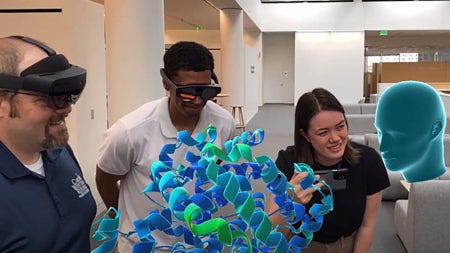
CWRU launches active learning and XR-enabled learning spaces in Nord Hall
Imagine stepping inside a living cell, walking through the human body, inspecting a bridge from every angle or exploring ancient spiritual spaces—all in real-time 3D, right in the classroom.
At Case Western Reserve University, new learning spaces and immersive technologies are turning those possibilities into classroom experiences.
“As the world around us changes, so too must the ways we prepare students for what comes next,” said President Eric W. Kaler, the Morton L. Mandel Presidential Chair. “Our investment in innovative learning environments and technologies is about preparing students for the future—giving them opportunities to learn, explore and solve problems in ways that reflect the world they will enter.”
The effort is grounded in a commitment to preserve the human connection between faculty and students, said Provost and Executive Vice President Joy K. Ward. As teaching evolves, technology should enhance—not replace—the interactions at the heart of learning.
“The heart of an exceptional education remains the spark that happens during collaborative problem-solving, conversations, experimentation and mentorship,” Ward said. “These new spaces and technologies give faculty additional tools to create those moments and bring learning to life.”
Based on more than a dozen pilot studies, students learning anatomy in extended reality (XR) have been proven to learn twice as fast and score 44% better on retention tests than those in traditional settings—likely because immersive, interactive 3D experiences make complex concepts easier to visualize, explore and understand.
With the university’s CWRUXR platform reaching over 1,600 students across disciplines like classics, materials science, pharmacology, and civil engineering, these new spaces give every professor the tools to innovate in ways that best serve their students.
New spaces for active and experiential learning
- Nord 356 | The dedicated XR immersive classroom: Equipped with Meta Quest 3 headsets, the classroom allows faculty to create custom 3D spatial content in as little as 20 minutes using no-code tools.
- Nord 204 | The active learning classroom: Designed for collaborative, active learning, this space replaces traditional rows of desks with flexible, reconfigurable layouts. Multiple displays, wireless casting and mobile whiteboards give students more opportunities to work together, solve problems and engage in team-based activities.
- Nord 200 lobby | The collaboration hub: A dynamic extension of the classroom featuring study booths, group pods and mobile whiteboards, giving student teams space to continue collaborating, brainstorming and building after class ends.
Support for CWRU faculty
CWRU faculty do not need specialized technical expertise to use the new teaching spaces. The university is providing support, training, and guidance to help instructors incorporate the technology into their courses as they so choose.
“We do not expect faculty to navigate new technologies and teaching approaches alone,” said Jeff Capadona, vice provost for innovation. “Whether you are rethinking a course activity, exploring a new instructional approach or simply curious about what these spaces and tools can make possible, there are resources and expertise available to help turn ideas into practice.”
Available resources include:
- The Interactive Commons, which offers specialized training, consultation, and hands-on guidance for faculty at every stage—from exploring possibilities to developing XR-enabled classroom experiences using conversational AI and no-code tools.
- [U]Tech’s Teaching & Learning Technologies, which provides comprehensive support and training in student engagement, collaboration, instructional design, active learning strategies and the use of teaching and learning technologies.
Claim your classroom experience
Slots for the upcoming semester in Nord 356 and Nord 204 are offered on a rolling basis.
- Try the tech: Reach out to the Interactive Commons to demo the Meta Quest 3 headsets and test out CWRUXR Deck.
- Get certified: Complete the quick XR orientation required before reserving Nord 356.
- Reserve your room: Book Nord 356 or Nord 204 directly through the Spartan Reservation System (EMS).