

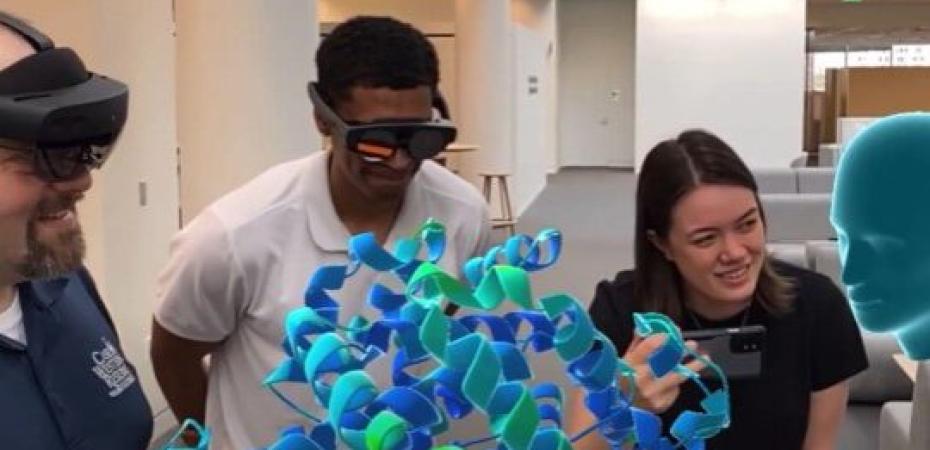
Shared XR for Anyone. Anywhere. Any Device.
CWRUXR (pronounced "Cruiser") is a framework developed at Case Western Reserve University that makes it possible for anyone — regardless of technical background — to create and deliver immersive XR experiences. Whether you're a faculty member with no coding experience or a developer looking for flexible APIs, CWRUXR meets you where you are.
CWRUXR includes tools for every level of creator:
- CWRUXR Deck — A 3D layout tool that works like PowerPoint. Design your content on a desktop and deploy it directly to XR headsets. Useful for laying out a series of 3D models or environments, prototyping in 3D, creating a virtual orientation for a room in the real world, or storytelling. CWRUXR deck displays 3D Models, 2D images, simple shapes, text, and Protein Data Bank (PDB) files. Sign up for an in-person training via Campus Groups, or email ic@case.edu to access the video tutorial.
- Software Development Kits (SDKs) — For developers, CWRUXR supports Python, .NET, R, and more for building fully custom XR experiences. This means developers don’t have to be 3D gaming engine experts to create an immersive experience well beyond the limits of a simple 3D slideshow. Sign up for an in-person training via Campus Groups, or request SDK by emailing ic@case.edu.
The following experiences are available now for faculty to use in their courses. Complete the CWRUXR badge training to get access to these experiences.
New content is added regularly. Contact us to request a topic or contribute your own.
- 3D DataViz: An XR data visualization experience for materials science students that renders complex research datasets in three-dimensional space for deeper analysis.
- 3D Symmetry: An XR experience for materials science students that visualizes crystallographic symmetry and atomic-level structures in three dimensions.
- Antikythera Mechanism: An XR experience that reconstructs and allows users to interact with the ancient Greek Antikythera mechanism, one of the world's oldest known analog computers.
- Asset Sender: Upload 3D models and display them immediately in XR.
- Biophysical Modeling: An XR tool for biomedical engineering students that brings complex biophysical simulations and models into three-dimensional, interactive space.
- BloodWork: An XR experience that immerses students in a holographic simulation of the bloodstream to study how blood cells, platelets, and drug therapies interact in the body.
- ChiReality: A gamified XR chemistry experience where students physically interact with oversized molecular structures to learn chirality — the three-dimensional "handedness" of molecules.
- Creativity Engine: An XR tool developed for human-centered design courses that helps students generate, explore, and prototype creative ideas in an immersive environment.
- econXplore: An XR data visualization tool that brings economic datasets to life in three dimensions, helping students identify trends and relationships that are difficult to see in flat charts or tables.
- HoloBridge Inspector (HoBI): An XR application that places civil engineering students inside a holographic bridge to inspect structural elements and learn about infrastructure integrity.
- HoloMolecule: An XR experience that lets students explore the 3D structures of proteins and membrane molecules, making invisible nanoscale biology tangible and interactive.
- HoloPolymer: An XR application that allows students to visualize and interact with the complex three-dimensional structures of polymer and macromolecular materials.
- Immersive Realms: An XR experience developed for art history courses that transports students into a virtual medieval chapel to understand the original context of medieval reliquaries behind glass at the Cleveland Museum of Art.
- Jaws At Work (JAW): An XR application for dental education that allows students to examine and interact with holographic models of jaw anatomy and dental structures.
- LightBox: A 3D data visualization tool that lets students arrange, sort, query, and tag large collections of digital images or data in extended reality to support research and trend analysis.
- Net2Work: An XR application that transforms a professional network spreadsheet into a holographic visualization, helping students understand and navigate the depth and quality of their connections.
- Planetary Toolbox: An XR application for planetary science courses that allows students to explore and interact with planetary bodies and geodynamic concepts at scale.
- Quantum Realm for Immersive Education (QuRIE): An XR learning environment that makes abstract quantum physics concepts tangible by allowing students to interact with and visualize quantum phenomena in three dimensions.
- Red Monastery: An XR project that digitally reveals the vivid painted interiors of Egypt's Red Monastery, making centuries of layered artwork visible and explorable.
- Sanctuary of the Great Gods at Samothrace: An XR reconstruction of an ancient Greek sanctuary that allows art history students to explore and study the archaeological site as it once appeared.
- SolidState: An XR application for electrical and biomedical engineering students that visualizes solid-state materials and device structures in three dimensions.