CWRU’s distinctive humanities are getting a major boost
They’re already a central force on campus. Now a historic gift gives a major boost to the university’s distinctive approach.
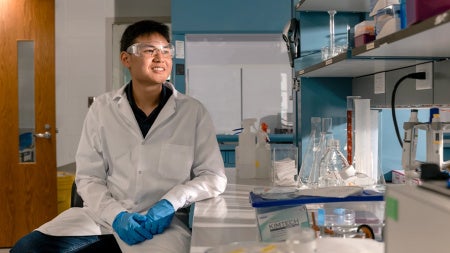
At Case Western Reserve University, an undergraduate in the new Humanity and Technology (HAT) major is co-developing a wearable device to help people who have difficulty interpreting or expressing emotions.
An MD student in the School of Medicine’s Humanities Pathway program is using poetry to help fellow future physicians on campus better understand patients struggling with substance use disorders.
And a recent alum who majored in English secured off-campus internships with help from the Baker-Nord Institute for the Humanities—and credits the experiences for his acceptance to a top-ranked law school.

These are just a few of the countless examples that illustrate how Case Western Reserve’s distinctive approach to the humanities—one that combines academic rigor, hands-on opportunities and an intensely interdisciplinary ethos—enriches the student experience and contributes to the greater good.
For years, the university has invested in humanities initiatives that champion core disciplines and reach across others, engage community members, and prepare students to thrive in the wider world.
“I think we have the potential to lead nationally.”—Timothy Beal, faculty director of the Humanity and Technology major
The most recent innovation—and one that benefits several campus initiatives—is the Experimental Humanities Program. It launched in 2023 with support from the Jack, Joseph and Morton Mandel Foundation and integrates the humanities and arts with science, technology, engineering and mathematics (STEM). The program also supports the Mandel Fellows, who are undergraduates in the faculty-created HAT major, has dedicated space in the new Roger E. Susi Interdisciplinary Research Building on campus and enhances an initiative, already two-thirds completed, to hire 100 new high-caliber faculty in nine strategic clusters, including “Humanities and the Arts in a Tech-Driven World.”
“This is a great opportunity for us to make sure that emerging technology is used and created with intention, thought and skill.”—Noah Medrano, a fourth-year student and Humanity and Technology major
Now the university is poised to take those efforts to a new level with a historic $125 million commitment from the Jack, Joseph and Morton Mandel Foundation and the Jack, Joseph and Morton Mandel Supporting Foundation. Announced in April, it’s the largest gift ever to the university and includes expanding the Experimental Humanities Program with a dedicated humanities building.
The gift creates the Morton L. Mandel Presidential Chair, with President Eric W. Kaler as the inaugural holder, providing the president with discretionary funding to invest in innovative and transformative initiatives. It will also more than double the scholarship endowment capacity at the Jack, Joseph and Morton Mandel School of Applied Social Sciences, expanding access to more future social work and nonprofit leaders from a range of socioeconomic backgrounds.
“Sciences study the mysteries of life, and humanities study the meaning of life,” said Mandel Foundation Board Chair Stephen Hoffman, who is also a CWRU trustee. Hoffman hopes the new funding will “inspire STEM students to think more broadly about what they do, and at the same time encourage other students to pursue studies in the humanities.”
The humanities-centered activity is impacting students, faculty and the greater Cleveland area. But Timothy Beal, PhD, a Distinguished University Professor and the Florence Harkness Professor of Religion, believes its impact could extend even further.
Beal, the faculty director for the HAT major, sees the constellation of practical, interdisciplinary approaches to the humanities at Case Western Reserve as a model for how other colleges and universities can reinvent such fields—and prepare students to become thoughtful, ethical leaders at a time when technological advances such as artificial intelligence (AI) are raising questions about what it means to be human and to live a meaningful life.
“I think we have the potential to lead nationally,” Beal said, pointing toward the comprehensive integration of humanities and STEM fields in the HAT major and the inclusion of dedicated spaces for the humanities in a STEM facility such as the Susi Building.
An Evolving Conversation
Case Western Reserve’s history makes it an ideal place to reimagine the humanities in an era of rapid and, at times, unsettling technological change.
In April, the Jack, Joseph and Morton Mandel Foundation and the Jack, Joseph and Morton Mandel Supporting Foun-dation committed $125 million to Case Western Reserve—the largest in the Mandel Foundation’s history and the largest gift ever to CWRU. The commitment will fund four areas:
- Establishing the new 50,000-square-foot Jack, Joseph and Mor-ton Mandel Humanities Building—a campus anchor for human-centered digital scholarship, interdisciplinary creativity and community partnerships.
- Expanding the Experimental Human-ities Program, providing additional opportunities for scholarships, stipends, mentorships and academic programs.
- Creating the Morton L. Mandel Presidential Chair, with President Eric W. Kaler as the inaugural holder, and providing the president with funds to invest in emerging opportunities and accelerate innovation and initiatives that amplify academic distinction and research excellence.
- More than doubling the existing scholarship endowment capacity at the Jack, Joseph and Morton Mandel School of Applied Social Sciences, expanding access to more future social work and nonprofit leaders from a range of socioeconomic backgrounds.
The university arose from the merger of an engineering school (Case Institute of Technology) and a liberal arts institution (Western Reserve University). As a result, “the humanities had to be in conversation with applied work and the STEM fields in a way that is not necessarily true in other research-intensive universities,” said Michele Tracy Berger, PhD, a professor of religion, the Eric and Jane Nord Family Professor and director of the Baker-Nord Institute for the Humanities.
By supporting the expansion of the Experimental Humanities Program through scholarships, mentorships and programming, and by funding a 50,000-square-foot humanities building that will host humanities-led interdisciplinary collaborations and community partnerships, the Mandel Foundation’s commitment promises to make that conversation even deeper and more distinctive.
“We see ourselves as an intellectual and social hub for the transfer of knowledge between us and the public.”—Michele Tracy Berger, director of the CWRU Baker-Nord Institute for the Humanities
A Model for Interdisciplinary Learning
Unlike a traditional double major in which students pursue two fields along separate tracks, HAT requires participants to fully integrate a humanities or arts field with a STEM one. Courses such as those delving into the responsible use of AI prepare students to address current issues, while learning to apply critical perspectives from the humanities to technology projects encourages them to ask questions about the ethical, social and cultural implications of technological change.
“My goal is to help students explore the social and ethical ramifications that arise from the interactions between people and technology,” said Rebecca Uliasz, MFA, PhD, an assistant professor of philosophy who teaches in the program. “In the case of students in engineering and scientific fields, I want to encourage them to think about the potential impacts of technology—both positive and negative—before they begin to develop actual things.”
Ultimately, Beal said, “we want our graduates to be able to say to a potential employer: ‘I’m not only a scientist or technician, nor am I limited to ‘soft’ skills. I am an effective leader who knows how to integrate my knowledge and skills in science and technology with my knowledge and skills in the humanities, and that’s what your organization needs.’”
The university’s prowess in preparing students to enter an economy increasingly influenced by AI is among the reasons it was named in the spring to Forbes’ list of “New Ivies,” a group of 20 colleges and universities recognized for graduating students highly sought by employers.
Noah Medrano, a Jack, Joseph and Morton Mandel Fellow in the Experimental Humanities and fourth-year student in the HAT program, has chosen to integrate computer engineering and philosophy and could soon be among those prized graduates. As a member of the Social and Physical Human-Robot Interaction Lab at Case School of Engineering, Medrano works on wearable technology to help people with post-traumatic stress and autism spectrum disorders connect with others and improve their emotional well-being. Now he is considering a capstone project exploring how digital technology could be used as a tool for conflict resolution—perhaps by investigating how the algorithmic distribution of short-form videos on platforms such as TikTok and Instagram can shape people’s perspectives and beliefs.
“This is a great opportunity for us to make sure that emerging technology is used and created with intention, thought and skill,” said Medrano, adding that the program has encouraged him to develop technologies that can help people lead “fruitful lives”—an aim often discussed in the field of philosophy.
“All these things that feed your passions can also feed your career.”—Erin Gentry Lamb, faculty lead for the School of Medicine’s Humanities Pathway
Humanities and Healthcare
Erin Gentry Lamb, PhD, who serves as faculty lead for the School of Medicine’s Humanities Pathway—one of nine pathways that provide interested MD students expertise in various fields—said the medical school was among the first in the country to incorporate the history of medicine into its MD curriculum in the 1950s. And it has long included the arts and humanities in the small-group Tuesday Seminars that introduce medical students to topics such as bioethics and health disparities.
“Case Western Reserve has always been an innovator in engaging with the humanities in this space,” said Lamb, who also co-directs the university’s undergraduate minor in bioethics and medical humanities.
The Humanities Pathway, which helps MD students think critically about the complex relationships among patients, healthcare professionals and culture, exemplifies that trend. Students attend weekly seminars, take courses outside the medical school, and work with a mentor on a scholarly or creative project.
“We’ve had students put on art shows, write chapbooks of poetry and compose music,” Lamb said. “But we also have students who have published research-based articles and reflective writing.”
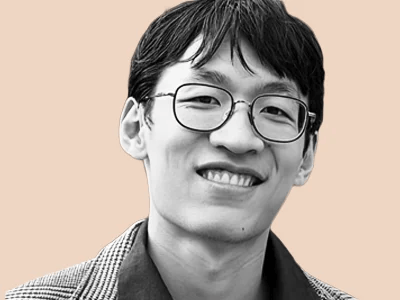
They also teach each other. Mishaal Omer, a second-year medical student, developed and led a poetry workshop for her fellow students that focused on substance-use disorders. “Through poetry and discussion, the workshop encouraged students to move beyond stigmatizing or purely clinical descriptions of addiction and engage more deeply with patients’ lived experiences, ambiguity and humanity,” Omer said.
In addition to addressing issues that aren’t covered in the standard medical school curriculum, Lamb noted that such activities can lead to publications, conference presentations and networking opportunities. She added that pathway graduates often point to the program as one of their most meaningful medical school experiences, and residency programs take a keen interest in their involvement.
“All these things that feed your passions can also feed your career,” Lamb said.
“I don’t think I would’ve gotten into law school without all these professional experiences or without the skills that the humanities inculcate.”—Lucas Yang (CWR ’26), a first-year student at Cornell Law School
Return on Investment
The connection between personal fulfillment and career preparation at CWRU is no accident. The humanities cultivate the skills (critical thinking and analysis, ethical reasoning and empathy) required to find one’s way in life—to understand what human beings are capable of achieving, what goals are worth pursuing, and what kind of world we ought to build for ourselves. And those same skills are in high demand in the marketplace: Surveys show employers value prospective employees who can reason critically and analytically, communicate effectively and engage in constructive disagreement—all things humanities students do on a regular basis.
Not surprisingly, employers also appreciate employees who have undergone experiential learning and dealt with real-world problems—and both play a central role at CWRU’s Baker-Nord Institute for the Humanities.
Our poetry workshop for medical students encourages them to “engage more deeply with patients’ lived experiences, ambiguity
and humanity.”—Mishaal Omer, a second-year medical student who developed the workshop
Established in 1996, the institute supports research and creative work in the arts and humanities; facilitates interdisciplinary collaborations between CWRU faculty and off-campus partners; and presents public lectures, performances and programs, including the annual Cleveland Humanities Festival, which it coordinates with major area museums, arts organizations and educational institutions.
“We see ourselves as an intellectual and social hub for the transfer of knowledge between us and the public,” Berger said. Last fall, for example, James Beard Award-winning Wampanoag chef Sherry Pocknett shared her knowledge of indigenous cuisine during a livestreamed workshop that had humanities students cooking alongside peers from the nutrition program in the School of Medicine.
Meanwhile, the institute’s Humanities@Work program helps connect undergraduates to internships with corporate, government and nonprofit partners.
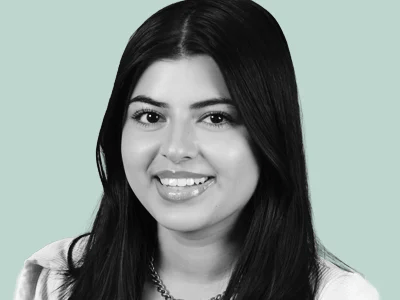
Lucas Yang (CWR ’26)—who now attends Cornell Law School after graduating with a BA in English, minors in computer science and studio art, and a concentration in film—credits much of his success at CWRU to the ways that Baker-Nord Institute helped him cultivate passions, such as writing and visual art, while developing practical skills. The institute hired Yang to help manage its website and design informational and promotional materials; provided him with funding so he could take an unpaid summer internship at a journalism nonprofit; and helped him land an internship in public TV and radio that led to a summer job.
“I don’t think I would’ve gotten into law school without all these professional experiences,” Yang said—or without the skills that the humanities inculcate, with their emphasis on dissecting difficult texts and “engaging with other people and their ideas.”
Those same skills and practices also help other students move through daily life and tackle existential concerns that the humanities have long grappled with: What is a good life, and how can we pursue it—individually, and as a society?
And as the students and faculty of CWRU are demonstrating, the dividends are well worth the investment. “We’re doubling down on the humanities,” said Berger, “because we see such important returns.”
Illustration by Blake Cale.