Forged for impact: Inside the Susi Building's Advanced Materials & Manufacturing research cluster
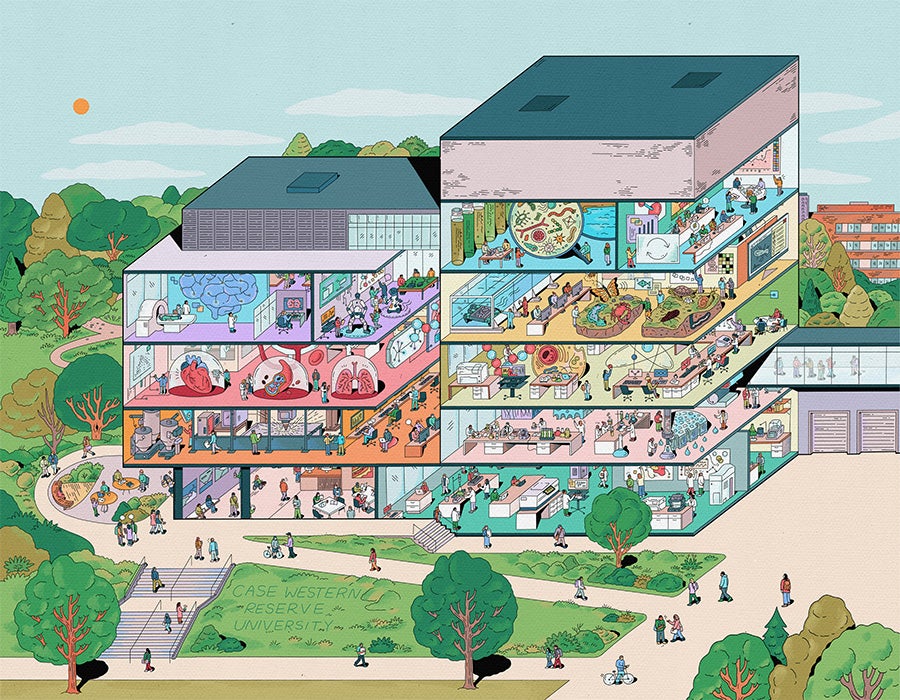
Case Western Reserve researchers are rethinking the materials behind everyday life—and the new Roger E. Susi Interdisciplinary Research Building is giving them the space to do it together.
This story is the third in a series introducing the research, people and building that will define Case Western Reserve’s next chapter of discovery. Over the coming weeks, we’ll go inside each of the seven research clusters and the resources that make the work possible.
Editor's note: This story was updated on Oct. 21, 2026, to reflect the new name of the building.
The texture of the paint on a wall. The durability of a car's paint and metal it protects. The viscosity of the shampoo you squeezed onto your hand this morning. The consistency of a meal reheated in the microwave. Materials—coatings, polymers, adhesives, membranes, hydrogels and so much more—are behind all of it.
A team of scientists within the Advanced Materials & Manufacturing research cluster at Case Western Reserve University will work to discover, develop and improve materials and the processes used to make them. The cluster is one of seven established for the Roger E. Susi Interdisciplinary Research Building, opening this fall.
Advanced Materials & Manufacturing brings together five faculty researchers who work across a variety of materials—hard, soft, biological, synthetic, porous, nuclear, chemical, rare-earth elements and more—for applications in energy, consumer products, human health and quantum technologies.
Metin Karayilan, PhD, assistant professor in the Department of Chemistry, and Lydia Kisley, PhD, Ambrose Swasey Associate Professor of Physics, both join from the College of Arts and Sciences, while the others come from Case School of Engineering: Chris Wirth, PhD, and Christine Duval, PhD, both associate professors in the Department of Chemical and Biomolecular Engineering and Svetlana Morozova, associate professor in the Department of Macromolecular Science and Engineering.
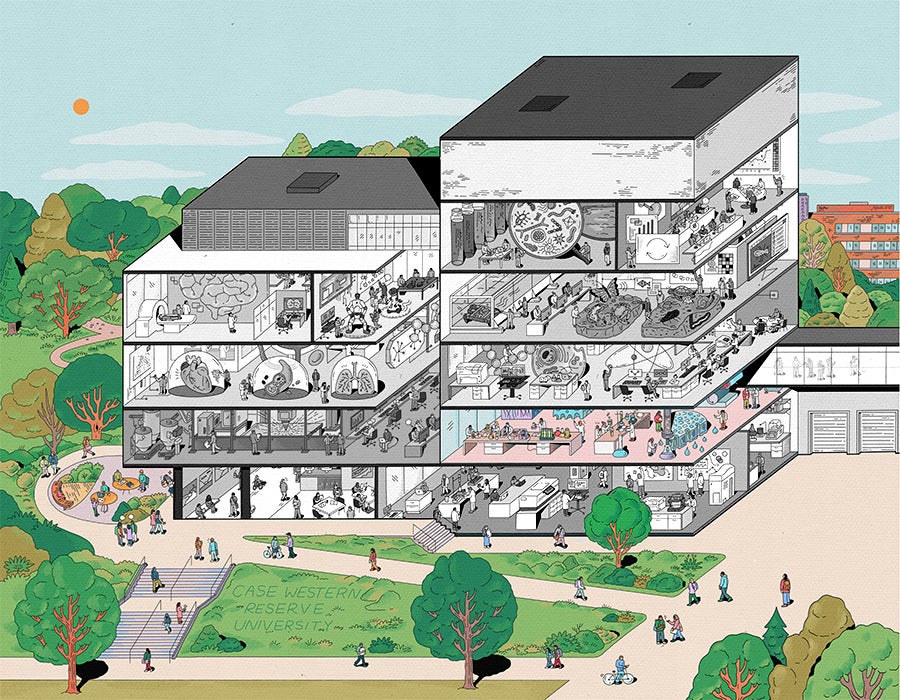
On the first floor of the Susi Building, the Advanced Materials & Manufacturing research cluster will train students for the advanced manufacturing workforce and deepen partnerships with the industries whose hardest problems they are working to solve.
'Together we can do so much'
From synthesizing something entirely new to refining and optimizing the performance of materials we rely on every day, the cluster members have all the skills needed for the entire lifecycle of creating new materials.
For example, Karayilan, an organic polymer chemist, could synthesize a novel recyclable polymer that Wirth, faculty lead for the cluster, can mix with solvents and other additives to formulate it into a liquid coating. Duval might modify a membrane that Kisley can characterize and measure.
"Each one of us has a specific set of skills, but together we can do so much," said Morozova, whose lab is focused on the physics of soft polymers and how their molecular structure determines how they flow, feel and behave.
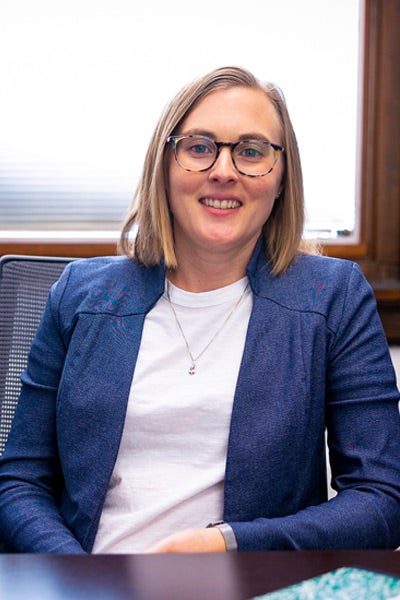
Kisley brings to the cluster advanced microscopy techniques to characterize materials at the scale of individual molecules. In one project, she's developing a silly-putty-like polymer material that allows researchers to stretch a sample and see the details inside of a cell with higher resolution. Karayilan's expertise in polymers intersects with this work, as well as Morozova's interest in how and why materials behave in certain ways. Kisley and Morozova have already published research together examining how collagen proteins assemble within biological matrices—and specifically how the stiffness and elasticity of the surrounding environment informs that assembly.
"The dream would be doing all those steps in a connected way, where each of the PIs is involved for one research question or material," Kisley said.
The cluster members are already well on their way to that vision, but working from separate buildings across campus slows their discovery. It can take students several days to coordinate sample exchanges between labs, such as those of Kisley and Duval, whose work on chemical separations includes ways to purify and separate rare-earth elements that are essential for electronics and green technologies.
Wirth recalls a time when his student walked a sample back from Karayilan's lab and began to work with it, only to realize the viscosity was too low for what they needed. In the shared lab in the Susi Building, they can offer that feedback in real time. Plus, students will learn from the perspectives, techniques and language of different disciplines, which advances innovation, Wirth said.
Setting the cluster and students up for success
It takes more than removing geographic barriers to build a genuinely collaborative, high-quality training environment in a cutting-edge shared research lab—which is why the Advanced Materials & Manufacturing cluster held three retreats over the summer to begin shaping their vision for the new space.
In the first of two faculty-only retreats, the five cluster members looked inward, drafting bylaws to identify shared values (high-quality educational experiences and leading-edge science) and to guide how they'd work together, onboard new members, manage conflict, run meetings and potentially shift direction over time. In the second, they turned outward, focusing on external engagement and stakeholder collaboration, brainstorming programming such as workshops, open houses and courses. They're planning a regular seminar series throughout the year, and an annual summer short course for students and regional professionals to learn techniques relevant to their work.
With that foundation established, they invited the entire team—undergraduates, graduate students, postdocs and research associates from all five labs—to the third and final retreat at the University Farm, where many met for the first time and began to learn the details of the cluster where they'll work, learn and build their careers.
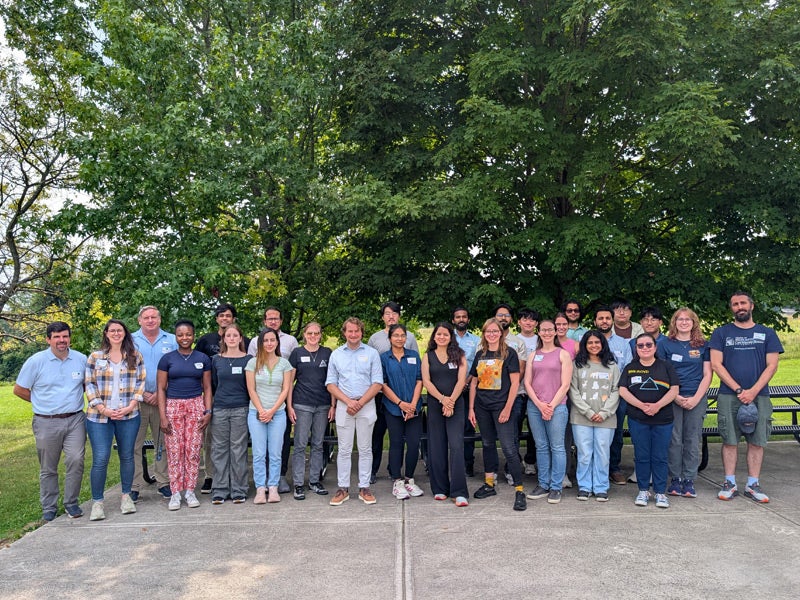
The Susi Building's collaborative environment mirrors the multi-sector research settings students will encounter in corporate science and national laboratories. That's by design.
"When you go to work a job, you're not working in just the physics department of some company," Kisley said. "There's always going to be different scientists and engineers that you're going to be working with."
The cluster's deep commitment to industry engagement also means students will gain direct exposure to various local partners while helping them solve key challenges.
Morozova's partners have included Lubrizol, Sherwin-Williams and Nestlé. She's helped Lubrizol reformulate Carbopol, a polymer molecule found in countless personal care products, replacing its conventional ingredients with a more biodegradable alternative. For Sherwin-Williams, her lab modifies molecular components of the formulations for paints and coatings to control properties like viscosity, surface texture and flow.
Kisley recently received funding from Sherwin-Williams to study metal corrosion. Right now, the standard method involves placing metal outside for two years and checking how the paint held up. Using her advanced microscopy, Kisley detects molecular signs of metal corrosion at the moment it starts in order to assess anti-corrosive coating.
"We drive our cars in the winter with all that salt," she said. "We want to figure out ways to prevent or slow down corrosion."
This is the type of high-value, use-inspired research the cluster is designed to produce; and Northeast Ohio is a particularly rich environment for this work.
Building collaborations across industry
Across sectors, businesses want sustainable resources with reliable supply chains. The cluster's research can help create those resources. Some companies are looking to change or improve formulations, advance their manufacturing techniques or improve their materials. The cluster hopes to work with local industry to make those advances.
In July, a partnership of 70+ area organizations convened and led by CWRU—known as NEO-SMART—won a prestigious U.S. National Science Foundation award of up to $160 million. Working to make Northeast Ohio a national innovation hub for advanced materials and manufacturing, the partnership and the Susi Building could benefit from each other's work and success.
The Advanced Materials & Manufacturing cluster is particularly aligned with NEO-SMART, Wirth said, pointing to both the expertise within the cluster and the common ethos of connecting research and industry applications among regional and corporate stakeholders.
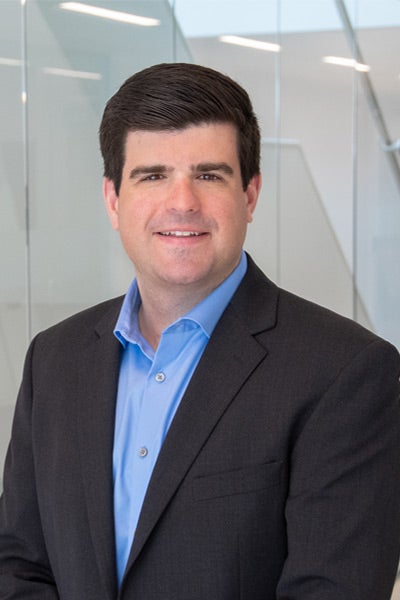
The federal spending package U.S. Congress approved earlier this year included $1.75 million for Case Western Reserve University’s Advanced Product Manufacturing Technologies Initiative—a wide-ranging effort to propel industrial innovation and talent nationally. The cluster is working to stand up a core facility to provide CWRU and external researchers with shared access to instrumentation that will be purchased with this funding, Wirth said.
"We're really thinking about what we put into that center to be responsive to corporate needs," he added.
Through the bylaws outlined over the summer, the team proposed a mechanism for collaborators to become cluster affiliates. Non-CWRU researchers collaborating on a grant, a peer at a national lab or corporate partners could attend meetings, join email listservs or use some of the bench space that was specifically left open for partnerships.
"If they have a particular type of experiment, a new type of chemistry that they want to test, a new formulation approach or anything like that they want to try out in the environment that is our cluster, then we're going to allow them to do that," Wirth said, adding that he's socialized the idea with manufacturers in the region who are intrigued.
In a region defined by its manufacturing heritage, the Advanced Materials & Manufacturing cluster will help write the next chapter, advancing the science behind the materials that industry needs and the innovations that everyday life depends on.