The Mandel School offers training for social workers and providers
Professionals in the field gains skills for responding to addiction, trauma, and burnout to help clients and themselves
For years, unintentional drug-overdose deaths in Ohio have ranked among the highest in the nation. Separately, burnout among social workers and other providers is endemic, fueled in part by demanding workloads, secondary trauma and the lingering consequences of COVID-19.
The COVID-19 and drug pandemics help explain why the Jack, Joseph and Morton Mandel School of Applied Social Sciences has staked out vital training territory.
The school is not only educating future social workers but providing programs for working professionals to help them better support clients and care for themselves.
“When we invest in the well-being and skills of our workforce, we strengthen the care they provide to individuals and families,” said Mandel School Dean Dexter Voisin, PhD. “That impact then ripples throughout the community, providing waves of positive change.”
Consider the work of the Substance Use Disorders Center of Excellence (SUD COE) at the school, which provides resources and training to treatment providers across Ohio.
In recent years, those providers began losing significant numbers of workers to burnout and found that incoming workers had less experience and knowledge.
SUD COE helped fill the gap by training thousands of professionals across hundreds of organizations. It gave them skills to better support clients and explained evolving practices—for example, that using medications to help treat opioid use disorder, an approach previously stigmatized, is slowly gaining acceptance in the field.
“If you’re a practitioner in Ohio coming up through some old-school programming, you get a lot of all-or-nothing thinking,” said Ric Kruszynski (SAS ’93), SUD COE’s director. “We’re doing considerable work changing attitudes as we are building skills.”
Healing the healers
Meanwhile other Mandel School experts nurture resilience.
They focus on providers in community health centers or hospital obstetrics units, for example, who are supporting parents experiencing the trauma of a stillborn baby or having to withdraw life support from an infant. But where do they turn for help?
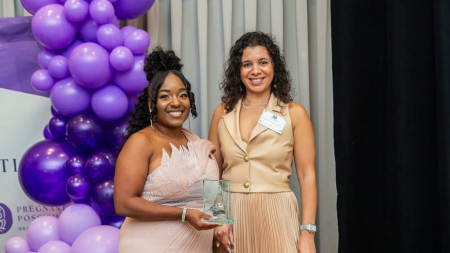
One answer is the CoHealing program, created by Jennifer King, DSW, a Mandel School associate professor and co-director of its Center on Trauma and Adversity. Launched in 2020 to address providers’ secondary trauma and burnout, CoHealing offers six monthly meetings and since last year has been funded by First Year Cleveland, which works to reduce infant mortality and is housed at the Mandel School.
Michaela Jackson-Smith (SAS ’23), a licensed social worker at the center, facilitates the program. She meets providers during the workday or at night to accommodate the needs of each cohort, and creates spaces where participants can build trust and learn grief-management strategies and other skills to heal.
So far, social workers and healthcare workers have attended the first two sessions, and another begins this fall with providers in a local obstetrics unit.
“The connection that we experience with others helps us heal as providers in the same ways we want our clients to heal,” Jackson-Smith said.
Photograph by McKinley Wiley