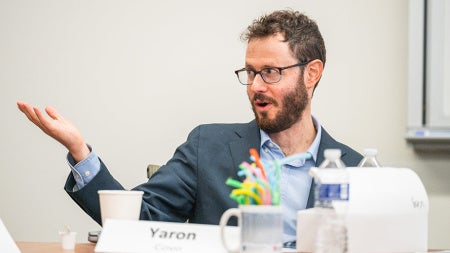
Meet a postdoctoral scholar bringing his experience in law to his work with the Social Justice Institute
A graduate of Case Western Reserve University School of Law, Alireza Nourani-Dargiri (LAW ’22), JD, clerked for Justice Melissa Hart at the Colorado Supreme Court before returning to Cleveland to be with his then-fiancée (now wife). When a position was posted at CWRU’s Social Justice Institute, Nourani-Dargiri was immediately compelled to apply.
He had long admired institute director Ayesha Bell Hardaway’s work, and he knew the role would give him the opportunity to teach. Since accepting the position in fall 2024, Nourani-Dargiri has taught SJUS 100: “Introduction to Social Justice,” a course offered in both spring and fall semesters for undergraduate students.
Bringing a background in research into the intersection of race and law to the classroom, Nourani-Dargiri helps students tackle challenging topics from multifaceted angles; he hopes they leave the course “better equipped to think critically and expansively about issues that impact their communities, including ways to analyze how inequality and injustices are created, identified, discussed, and potentially addressed,” he said.
As a Muslim and person of color, Nourani-Dargiri finds it critical to foster a sense of belonging and model what his students can become.
“As CWRU students will be leaders in many facets of our society, I feel particularly honored to help guide this process along and provide a space for students to formulate their ideals,” he said.
Nourani-Dargiri also remains connected to the School of Law, where he assists teaching courses, including one on appellate advocacy.
“As I do with my undergraduate students, I also consciously engage with my law students away from the traditional podium to foster their education, build networks and even secure jobs,” he said.
These efforts are closely aligned with Nourani-Dargiri’s career goal of joining a faculty.
“Working with students is where my passion lies, and being able to work on my scholarship is a welcomed bonus,” he said.
Learn more about Nourani-Dargiri’s research and experiences.
Answers have been lightly edited for clarity and length.
1. What do you do in your work with the Social Justice Institute?
In addition to teaching SJUS 100, I help manage a variety of the institute's research projects, as well as host events and lectures. The institute's goal is ultimately to create a just world, and that involves not just the creative research the institute engages in, but also maintaining relationships with community members who do the work on the ground. I feel rather fortunate to have a small hand in what it does and am excited to see how the institute progresses for years to come.
2. Can you tell us a bit about your academic research? What topics do you specialize in?
My research is largely on the intersection of race and law, with particular interest in disparate criminal law practices and civil/human rights violations. My scholarship has an emphasis on bail reform, but I have also published in the areas of protesting, double standards in international law, and gaps in the law school curriculum.
3. How has your background in law informed your work in social justice?
A common misconception is that the law rights all wrongs, but that isn't entirely true. True, the law can right wrongs, but it is often slow-moving and can even be used to separate, ostracize, and exacerbate issues.
I try to bring my background into my classes to demystify what a lawyer looks like and how my students can do a lot of good for their society, regardless of what field they go into. My background, perhaps especially as a former clerk, has shown that everyone has a part in the progression of our society, not just lawyers and judges. Even here, administrators, faculty, staff, as well as students all have a space in how our university progresses or regresses.