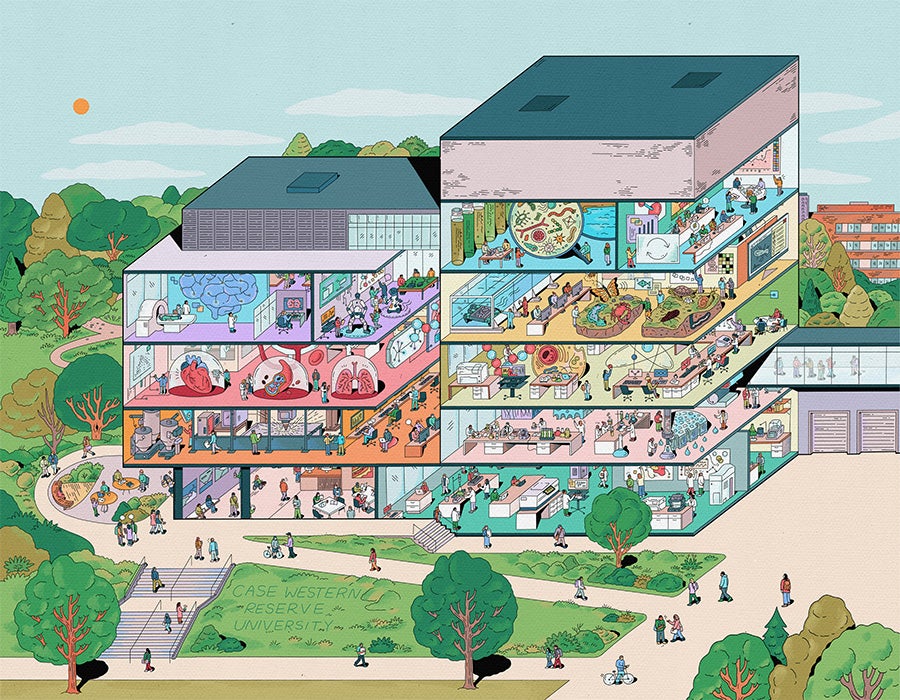
Nerve center: Inside the ISEB’s NeuroTechnology research cluster at Case Western Reserve
Researchers who have spent decades restoring individuals’ movement, sensation and function are moving in to drive further solutions to neurological conditions
This story is the sixth in a series introducing the research, people and building that will define Case Western Reserve’s next chapter of discovery. We’ll go inside each of the seven research clusters and the resources that make the work possible.
For half a century, Case Western Reserve University has become increasingly well known for expertise in neurotechnology and neural engineering—fields in which engineering and neuroscience principles unite to address the human nervous system. CWRU researchers have developed technologies that reach the brain, the spinal cord, and the body's vast network of peripheral nerves to restore what neurological diseases and injury take away: sensation, function and movement.
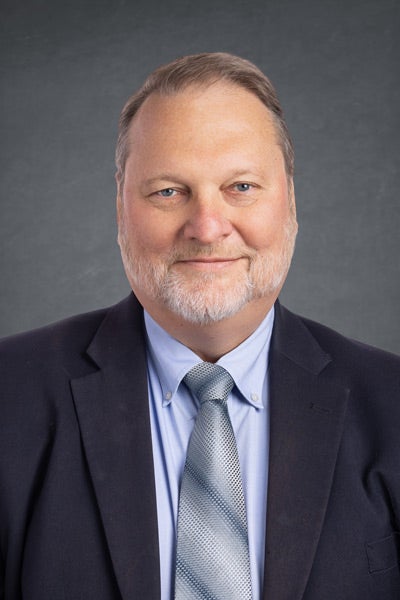
The impact’s been undeniable. CWRU's cutting-edge research, along with Northeast Ohio’s world-renowned clinical care and ecosystem of neuroscience-focused companies, has made Cleveland a world leader in neurotechnology, said Robert Kirsch, PhD, professor in the Department of Biomedical Engineering at Case School of Engineering.
"But we're kind of scattered around a little bit," said Kirsch. "We're in different departments and different institutions."
As discoveries advanced, researchers seized opportunities to bring together people from different disciplines. They deepened partnerships with renowned local health systems, found new clinical applications for emergent technologies and built institutional structures—including CWRU's Neural Engineering Center and the Cleveland Functional Electrical Stimulation Center—to anchor and support the work.
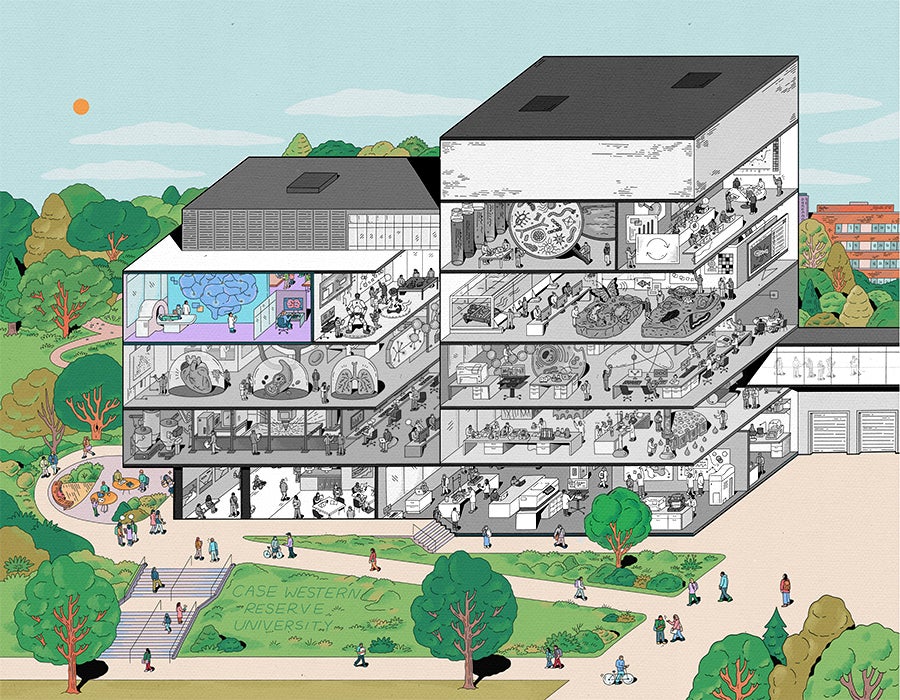
In the Interdisciplinary Science and Engineering Building (ISEB), which opens in October, researchers joining CWRU’s NeuroTechnology research cluster will take this work even further, driving new technologies and expanding into new clinical areas, while building on research that has spanned institutions, disciplines and decades. That generational reach is written into the cluster itself.
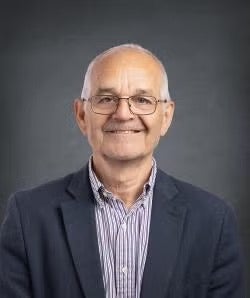
Christopher Pulliam, PhD (CWR ’06; GRS ’10, ’13, biomedical engineering), assistant professor in the Department of Biomedical Engineering, is a former student of Kirsch, while Steve Majerus, PhD (CWR ’08; GRS ’08, ’14, electrical engineering and applied physics), once sat in the classroom of Dominique M. Durand, PhD (GRS ’76, biomedical engineering)—a faculty member who's spent 45 years probing the nervous system’s mechanisms to address various types of neurological conditions.
"Interaction can take place and collaboration can flourish” in the ISEB, Durand said. “That's what we're doing: science right now."
Once settled on the third floor of the ISEB, these researchers will be four of the 10 seeking to develop technologies that interface with the brain, spinal cord and peripheral nervous system to find and create solutions to neurological conditions that affect millions—such as stroke, spinal cord injury, chronic pain, movement disorders, and cognitive decline.
From the bench to the bedside—and all the expertise between
Representing different specialty areas, the NeuroTechnology cluster members will tackle discovery, translation and commercialization together, spanning the bench-to-bedside model.
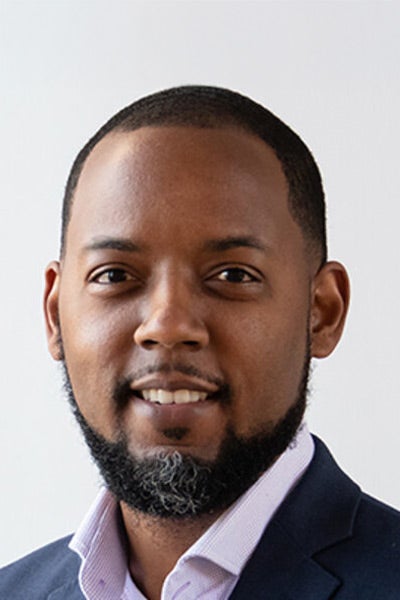
For instance, Pulliam's research primarily involves the application of wearable or implantable technology and machine learning. He works with existing technologies, integrating them in new spaces, finding new ways to apply them to address different clinical needs. He also looks at new ways to measure patients’ quality of life day-to-day, beyond what’s captured in a lab or seen in a clinical setting.
By moving into a space with folks who are working on new interventions—including Kirsch, Abidemi Bolu Ajiboye, PhD, chair of the Department of Biomedical Engineering, and Emily Graczyk, PhD (GRS '18, biomedical engineering), assistant professor in the department—the potential reach of Pulliam’s efforts is sure to expand.
As one example, all three investigators are part of the ReHAB study, which is advancing a technology to help people with paralyzed limbs reconnect individuals’ hands and arms to their brain, to restore sensations and functions. The study combines Kirsch’s expertise in functional electrical stimulation (FES), Ajiboye's study of brain-computer-interface (BCI) and Graczyk’s research of sensory restoration.
"Then on the other end of the spectrum you've got people like Steve Majerus and Rui Cao and others, who are more on the technology side," Pulliam said. "And maybe there's some partnerships to take their expertise and some of the applications I might be interested in, and you shake those up in a bottle and see what comes out."
Kirsch sees the NeuroTechnology cluster pushing forward new technologies, such as optical stimulation (a technique using a focused laser beam to activate or deactivate neurons); neural and computational modeling; and focused ultrasound—a specific type of neuromodulation that can penetrate through the skull and effect neurons in a small area of the brain
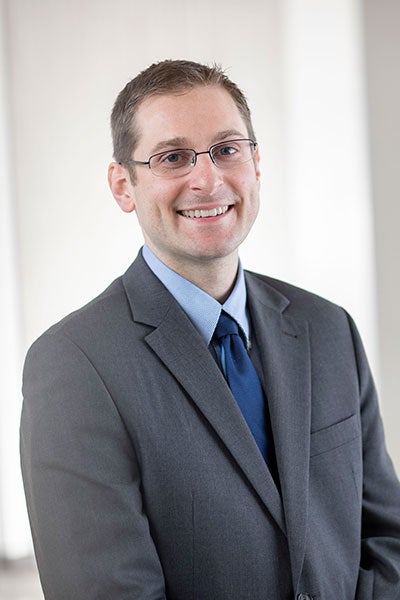
He also anticipates a number of applications for artificial intelligence (AI) in the ISEB, such as using it to understand signals the cluster’s researchers record or to develop control systems for some of the applications they use.
For some members, a key benefit will be having easier access to the core facilities available in the ISEB. These are shared resources—equipment, services and expertise—available to CWRU researchers and external partners. The NeuroTechnology team is establishing one of their own: the Neural Imaging and Histology Core will list the cluster's major equipment, allowing fellow researchers within and beyond the cluster the opportunity to use it.
This is in part about visibility, especially for fellow cluster members. When instrumentation is divided across the campus and researchers don't know what's available to them, they may not consider certain ideas.
"But as soon as you start realizing, 'Oh, I have a screwdriver and a hammer and a saw,' you start seeing projects that you can do with those tools," said Andrew Shoffstall, PhD (GRS '13, biomedical engineering), Nord Distinguished Associate Professor in the Department of Biomedical Engineering.
New frontiers
As new ideas already begin to flow, there’s no question that what the NeuroTechnology researchers can pursue together in the ISEB is expansive.
For someone with a spinal cord injury, everything below their shoulders might be paralyzed. To date, CWRU researchers have focused on restoring one function, like hand movement. The next step would be for researchers to pull multiple functions together for a broader solution, an approach that has the potential to drive farther-reaching impacts, said Kirsch.
As executive director of the Cleveland FES Center—a consortium among CWRU and its clinical partners across Northeast Ohio—Kirsch aims to advance research, education and clinical practice in the fields of biomedical and neural research, engineering, medicine, and rehabilitation, all approaches he’ll integrate within the ISEB.
Kirsch already sees several possible new frontiers for the NeuroTechnology cluster's research, each rooted in the science that CWRU and its partners have spent decades developing.
One involves mental health, the number one class of neurological disorders. Developing solutions in this area requires new technologies and presents a number of complications, including ethical and regulatory questions. Researchers have started considering those questions and taking some initial steps in the area, and Kirsch sees great potential.
Also in the ISEB, NeuroTechnology cluster researchers may explore other areas that are controlled at some level by the nervous system, including blood pressure and heart rate. With the same foundational FES principles they've used extensively to restore movement, they could address aspects of cardiovascular function, perhaps leading to possibilities in pain mitigation and inflammation.
"Instead of taking pills every day for a certain condition that have side effects, you could stimulate the right neurons and have the ability to turn it off and turn it on, not affecting other systems," Kirsch said. "That's the goal there."
In recent years, findings from Durand's lab have opened up a number of questions for applications in cancer.
"We can record neural signals from tumors," Durand said. "There are neurons in tumors and they actually are talking."
Because his team has limited understanding of the cellular mechanisms of tumor growth, he needs collaborators to make progress on this. In the ISEB, he’ll have expertise right next door.
An opening for business
The ISEB not only positions the NeuroTechnology cluster and the university to tackle bigger challenges, but to connect findings from those efforts with the broader public.
This model promises great potential for companies facing challenges, said Pulliam, a three-time CWRU alum who worked in the medical device industry before returning to the university as a faculty member. Industry challenges require a range of experts coming together to solve them, and with the ISEB, CWRU researchers are better poised to deliver.
Fun fact: More than half of the 10 faculty members who make up the NeuroTechnology cluster in the new Interdisciplinary Science and Engineering Building are alumni, having earned a degree at CWRU.
Abidemi Bolu Ajiboye, PhD, chair of the Department of Biomedical Engineering at the Case School of Engineering
Rui Cao, PhD, assistant professor in the Department of Biomedical Engineering
Dominique M. Durand, PhD (GRS '76, biomedical engineering), director of the Neural Engineering Center and professor of biomedical engineering
Emily Graczyk, PhD (GRS '18, biomedical engineering) assistant professor in the Department of Biomedical Engineering
Michael Jenkins, PhD (CWR ’04; GRS ’08, biomedical engineering), professor in the Department of Biomedical Engineering
Robert Kirsch, PhD, faculty lead for the cluster and the Robert and Brenda Aiken Professor of Biomedical Engineering in the Department of Biomedical Engineering
Steve Majerus, PhD (CWR ’08; GRS ’08, ’14, electrical engineering and applied physics), assistant professor in the Department of Electrical, Computer and Systems Engineering
Michael Moffitt, PhD (GRS ’00, ’04, biomedical engineering), associate professor in the Department of Biomedical Engineering
Christopher Pulliam, PhD (CWR ’06; GRS ’10, ’13, biomedical engineering), assistant professor in the Department of Biomedical Engineering
Andrew Shoffstall, PhD (GRS '13, biomedical engineering), Nord Distinguished Associate Professor in the Department of Biomedical Engineering
Kirsch hopes the NeuroTechnology cluster will be among those experts, with the ISEB serving as a "front door" to CWRU research and resources. He envisions an open hub where the next generation of neural engineers are trained, and where industry partners can come to get help on some of their most pressing challenges.
"We really do want to facilitate industry," he said. "If they need expertise in certain areas, we can provide it. We will do what we can do to help grow the neurotechnology industry in the region."