From the South Pole to startup life: How a CWRU alum is using AI to improve wireless networks
A conversation with James “JT” Sayre (CWR ’03; GRS ’14, physics), co-founder and chief technology officer of eino
A wireless network can be running smoothly today and strained tomorrow.
As demand shifts, telecommunications companies must decide where more capacity will be needed, which upgrades will have the greatest effect and how to avoid spending money in the wrong places.
Software startup eino is working to make those decisions less uncertain.
The Boulder, Colorado-based company uses artificial intelligence, predictive modeling and network data to forecast future performance, test the effects of possible changes and recommend where clients should direct their time and capital.
Leading the technical work is James “JT” Sayre, PhD (CWR ’03; GRS ’14, physics), eino’s co-founder and chief technology officer.
His path into telecommunications began in an unlikely place: the basement of Rockefeller Building at Case Western Reserve University, where he worked on telescope detectors cooled to about minus 459 degrees Fahrenheit.
Sayre arrived at Case Western Reserve as an undergraduate studying mechanical engineering and history. After graduating, he remained at the university as an IT administrator in the School of Graduate Studies and took advantage of an employee benefit that allowed him to enroll in courses.
One course in stellar physics turned a lifelong interest in the universe into a new career direction.
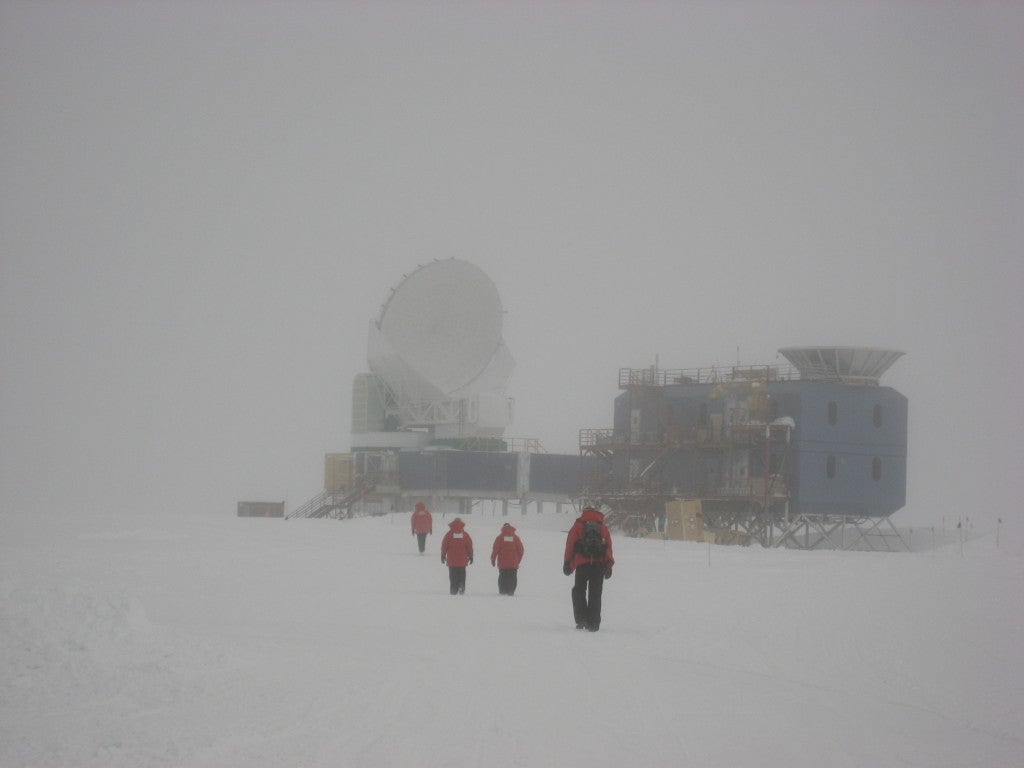
Sayre went on to earn his PhD in physics as a member of the South Pole Telescope collaboration. He helped develop detectors for the telescope’s cameras, created algorithms to analyze the resulting data and traveled to Antarctica to install equipment in temperatures that could fall to minus 50 degrees.
After a postdoctoral appointment in astrophysics and space astronomy at the University of Colorado Boulder, Sayre moved into data science at a national telecommunications company. There, he used network data to identify patterns, forecast demand and develop plans for expanding infrastructure.
That combination of physics, software development, data analysis and telecommunications experience eventually positioned him to build eino.
In the conversation below, Sayre discusses following his curiosity into astrophysics, leaving academia, finding the startup environment he had been missing and why building a company reminds him of working at the South Pole.
What drew you further into physics after that first stellar physics course?
I have always enjoyed studying difficult subjects with the attitude that it does not matter whether something is hard or extremely technical. You keep working at it until it begins to make sense.
The course was partly a way to indulge a lifelong fascination with how the universe works and partly a test. I wanted to see whether I could keep up with a deeper exploration of the subject than what I had encountered in documentaries.
I worked hard, realized I could handle the coursework and found that the subject became even more interesting as it grew more technical. I decided to keep going.
What did your work with the South Pole Telescope collaboration teach you about solving difficult problems?

The work required patience, precision and a willingness to keep troubleshooting when the answer was not obvious.
We spent hours babysitting test systems cooled to about minus 459 degrees Fahrenheit while developing the telescope’s detectors. I also created algorithms for identifying unusual data, estimating noise, filtering signals and classifying the information the telescope collected.
At the South Pole, even basic physical tasks could become difficult. You might be outside drilling holes and turning screws when it was minus 50 degrees.
It was challenging, but it was also a wonderful experience. There was a great deal of satisfaction in solving difficult problems as part of a team working at the edge of science and technology.
What ultimately convinced you to leave academia?
Honestly, I could have been a student forever. I could probably find a topic interesting enough to carry me through a degree in almost any field.
I loved graduate school and postdoctoral life. You are surrounded by smart people who share the same drive and passion to learn.
But academia is a difficult career path, particularly in a small field. The competition for a limited number of positions is intense, and the road to a stable, comfortable career can be daunting.
At the same time, there was an entire world outside academia filled with interesting problems to solve and a better opportunity to create the kind of life I wanted for my family.
Data science offered a way to apply the analytical and technical skills I had developed through physics to a different class of problems.
What did your experience in telecommunications reveal about the problem eino could solve?
It showed me the gap between having enormous amounts of data and being able to use that data to make a clear decision.
A telecommunications company may have detailed information about its network, but the difficult part is turning it into an answer: Where will additional capacity be needed? What will happen if we make a particular change? Which projects should come first?
My work involved identifying patterns in network data and developing optimized construction plans. We were trying to understand where demand was changing and how resources could be directed more effectively.
Those are the kinds of decisions eino is designed to make clearer.
What is your role in turning that idea into a working platform?
As chief technology officer, I lead the development and refinement of the platform from beginning to end.
That starts with data engineering and how client information enters the system. It continues through the development and quality control of our predictive models and ends with how we communicate performance insights and upgrade recommendations.
I also serve as the primary architect of our cloud-based software. My focus is making sure the platform remains flexible, reliable and capable of responding to the different needs of each client.
The goal is not simply to produce more data. It is to give clients something they can act on before a network problem emerges or money is committed to an upgrade.
Katie Critchett is a fellow with the Alumni Venture Fund at the CWRU Veale Institute for Entrepreneurship.