Studying human-robot interaction, CWRU researcher explores tech-enabled mental health support
Editor’s note: Jasmine Vo, the author of this story, is a student employee in the University Marketing and Communications department. She is a fourth-year student majoring in communication sciences.
As she coped with the grief of suddenly losing her dad during her undergraduate degree, Alexis E. Block, Dr.sc, longed for a hug from her mom and grandmother. This prompted an important question: Can robots provide emotional support for humans?

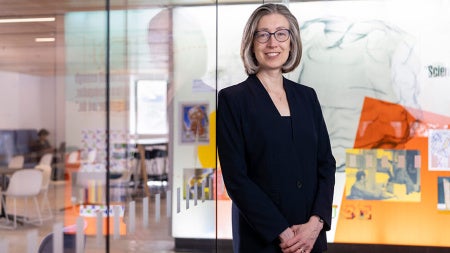
For Block, the answer is one day, hopefully. She worked through her master's and doctoral studies to develop the first human-sized interactive hugging robot with visual and haptic perception, and is now an assistant professor in the Department of Electrical, Computer, and Systems Engineering at Case School of Engineering. Block’s research explores the ways robots and technology can provide empathetic, emotionally intelligent responses and address mental health challenges to enhance human well-being.
Using robotics to emotionally support humans has been a compass for many projects in her lab — the Social and Physical Human-Robot interaction (SaPHaRI) Lab. The SaPHaRI Lab is part of the Human Fusions Institute (HFI), a Case Western Reserve University institute pioneering research in neural engineering and human-technology integration.
The SaPHaRI Lab is developing wearable devices that help people communicate their emotional states and desire for interaction and robots to provide mental health support to astronauts in space, among other innovations.
“HFI provides shared resources and a highly collaborative, multidisciplinary environment that supports the research of labs with a shared mission, like SaPHaRI,” said Mark Mykleby, executive director of HFI.
Building compassionate robots with human-centered design
AstropPsych, a project that the SaPHaRI Lab developed, aims to provide emotional support for astronauts in space. It also has applications on Earth for people experiencing real or perceived barriers to access support.
For astronauts in space, a delay in communication between space and ground can greatly impact mental health support provided by therapists back home. This delay is unavoidable and could last up to 20 minutes one way when astronauts travel further from the Earth, according to Moiser et al.
Robotic frameworks like AstroPsych aim to provide timely, temporary care until direct access to a human therapist becomes available. However, this development does not aim to replace the role of human therapists, but to lower barriers to accessing help and broaden accessibility, said Block.
Block and her team always consider the interaction between humans and robots holistically. Designing a robot to perform a task is only part of the challenge; the team must also consider how the robot will interact with the humans around it.
Even in relatively simple scenarios, human perception matters. For example, a robot delivering a can of soda could complete the task successfully, but if it moves too quickly while handing it over, the motion might startle the person receiving it. When developing robots for emotional connection or encouragement, human perception is even more important.
Another ongoing project in SaPHaRI Lab is The Robotic System for Optimized Adaptive inteRaction (RoboSOAR), where the team studies how a robot’s initial greeting shapes human perceptions and willingness to interact. RoboSOAR aims to improve early-stage interactions to enhance its later connection and facilitate bonding with humans.
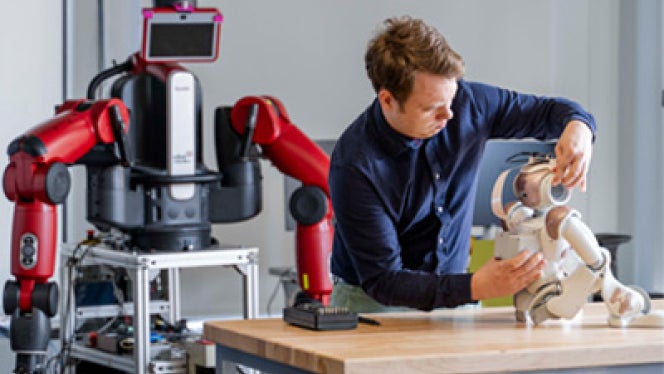
Austin Wilson — graduate student, aspiring astronaut and member of the SaPHaRI Lab — is developing a robot behavioral model that could provide mental health support for astronauts or in other communication-limited or delayed environments. The pipeline is designed to supplement human therapists, intentionally keeping them in the loop for professional oversight, when communication is limited.
‘Technology in the service of humanity’
HFI provided Block with the ideal interdisciplinary collaborative environment to conduct this research. Before joining HFI, Block was often asked to “downplay certain aspects while highlighting other aspects of [her] research,” she said.
“However, I believe that what makes my research interesting is the unique combination of different disciplines,” said Block, who also served a Veale Faculty Fellowship with the Veale Institute for Entrepreneurship in 2024. “That’s what drew me to HFI and CWRU … The mission of the institute — technology in the service of humanity — aligns perfectly with my mission to develop robots and technology to address mental health concerns.”
The institute gathers researchers who share a commitment to bridging the gap between humans and advanced technology in a manner that is just, ethical, and centered on the human. Together, they aim to foster innovations that enhance human capabilities and improve the quality of life. Through collaboration, researchers can exchange and refine their research methods and benefit from shared expertise and resources.
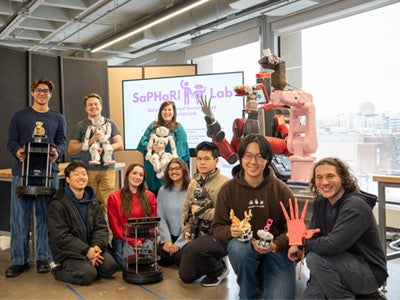
Block founded the SaPHaRI Lab when she joined CWRU and HFI in 2023. Since then, she has worked with more than twenty undergraduate and graduate student researchers in her lab. She’s seen many of them grow personally and professionally.
“I want my students to leave my lab not only as strong engineers, but as empathetic ones. The same principles that guide my research on empathetic robots also guide how I mentor: understanding different perspectives, listening carefully, and designing technology that serves people,” Block said.