

May, 29. 2026
The Writing Program Research Group (WPRG) was created in Fall 2025 to explore the use of generative AI in academic writing. The first three students to form the group–Tara Chatty, Edward Han, and Hannah Zhu–had a productive and enlightening first year that provided the Writing Program, writing faculty, and the university with important data about how students interact with generative AI.
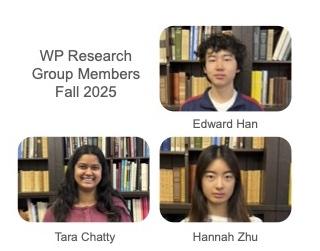
The WPRG’s first task was to evaluate a new Canvas site that provides material and support to both faculty and students about generative AI in the context of writing development. The three students turned their keen and critical eyes on the student-oriented modules in the Canvas site to offer feedback to the designers, making the modules much more interesting and accessible to student users in the future. The three also researched and created an annotated bibliography for the Canvas site, highlighting AI-related articles about various disciplinary areas. These articles are now available to faculty to use in class discussions about the effects of AI on their areas of study.
In its second writing-and-AI-related project, the WPRG reviewed data collected from an AIQS Student AI Use Survey that had been sent to all first-year students while they were enrolled in their first-year writing seminar (AIQS). The students provided important interpretations of the survey data from the Fall 2025 collection. They also designed and led focus groups with students to gather more nuanced information from first-year students about their uses of AI for reading, writing, and researching. As a result of their work, they prepared a report of their findings for the Writing Program, and presented their data at a UCITE Lunch ‘n Learn session and at the Writing Program’s year-end events for AIQS and Communication-Intensive (CI)-teaching faculty in April 2026. Their key findings included the following.
Participants reported using a variety of AI tools including ChatGPT, Gemini, Claude, and university provided tools such as Copilot. It was primarily used for:
- Solving or understanding homework problems
- Generating study materials or practice problems
- Explaining hard to understand concepts
- Summarizing readings
- Brainstorming or outlining written assignments
Students usually used AI as a last resort or supplementary tool, usually when:
- Assignments felt overwhelming
- Other resources (peers, tutors) were not helpful
- They needed a quick solutions
Many students avoided using AI in writing assignments due to ethical concerns. Students generally agreed that using AI for brainstorming, outlining, or research was acceptable. However, it crossed a line and was considered cheating when copied directly or violated the assignment rules.
All students agreed that AI will be essential in future careers and they need to learn how to use it effectively instead of becoming fully reliant on it. Students expressed interest in learning how to use AI in specific fields, prompt engineering, and hands-on learning (rather than lecture based).
Based on the success of this work, and acknowledging the limitations in generalizing from a couple of small focus groups, the Writing Program will conduct additional surveys and focus groups with the first-year students in AIQS courses next academic year.
In Spring 2026, the WPRG’s mission expanded with a project brought to the Writing Program by senior Ify Chidi, who wanted to know what CWRU seniors and recent graduates had to say about their writing development during their time at CWRU. After getting IRB approval, Ify sent a survey to students who had completed the SAGES Program (the university’s previous general education writing sequence of five courses), seeking answers to questions about the students’ experiences with writing in college by way of a survey or an interview. Despite the busy time of the semester, Ify received fifteen complete survey responses and was able to conduct one interview, gaining a lot of insight into how students perceive their own writing.
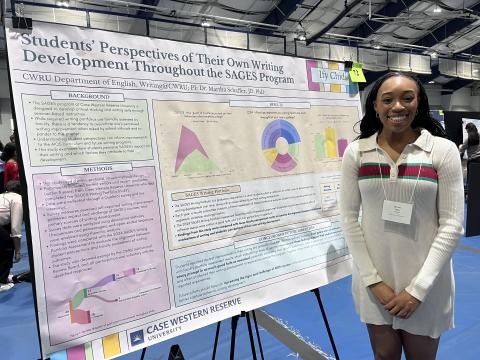
While the SAGES Program has done extensive assessment with the students’ portfolio submissions each year, a direct survey to students and by students had not been a piece of that protocol. This gives the Writing Program, and the Unified General Education Requirements, important information by this essential community: the students who take writing-intensive courses. Ify presented her work at Intersections, receiving the prize for Best Poster Presentation, and to the Writing Program Administrators. Her findings gave the Program important information to consider, and ideas for future inquiry into students’ writing development and effective teaching practices.
Like the AI and writing research completed by Eddy Han, Tara Chatty, and Hannah Zhu, Ify’s study provides opportunities for undergraduates to conduct humanities research and to contribute meaningfully to the programmatic work that shapes all students’ experiences at CWRU.
Undergraduate students who find this research interesting may contact us at writing@case.edu to apply for the WPRG AY 2026-27.