

University programs guide students on the path toward commercialization
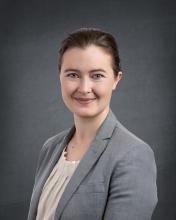
While working on her doctorate degree in biomedical engineering at Case Western Reserve University (CWRU), Brecken Blackburn conducted research on optical coherence tomography (OCT) elastography. She gained invaluable insight into moving her project from the lab to the marketplace as a CWRU Translational Fellow.
“The Translational Fellows Program helped me explore and deepen the translational push on our imaging technology, which we are now working on with commercial partners,” says Blackburn, now a research assistant professor in the Department of Biomedical Engineering. “More broadly, it gave me the encouragement and background knowledge to help me co-found two medical device start-up companies.”
The fellowship program is one of several translational initiatives spearheaded by the university to develop and inspire the pursuit of commercial opportunities in the biomedical field.
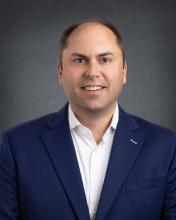
“It’s so important to drive the culture of translation and to feed the pipeline of strong projects,” says Stephen Fening, an associate vice president for research at Case Western Reserve University, professor of biomedical engineering and managing director of the Case-Coulter Translational Research Partnership (CCTRP).
The CCTRP is a high-profile platform on campus that promotes translational research and supports collaborative translational research projects to address unmet or poorly met clinical needs. However, the university offers other programs for undergraduates, graduate students and postdoctoral researchers with an entrepreneurial itch. These include the Three Minute Thesis competition, the Translational Fellows Program and I-Corps@NCATS training.
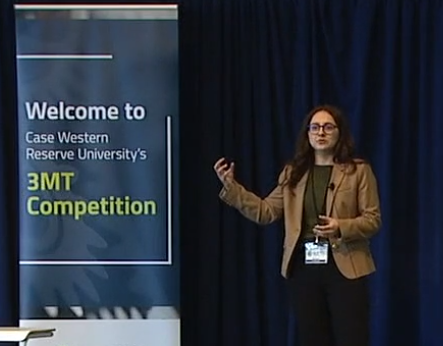
Three Minute Thesis (3MT™) – Case Western Reserve University will hold its fifth annual 3MT competition in February. Developed by the University of Queensland and held at over 900 institutions across more than 80 countries, the competition cultivates students’ presentation and research communication skills. Participants present short pitches about their research using only one accompanying slide.
“For people in deeply technical areas, like most researchers, it’s hard to communicate with people outside their specialty. But a lot of the magic in translational research and innovation happens when you connect with people from other disciplines,” says Fening. “So, it’s a great skill to be able to communicate the impact of your work to a more general population.”
Fening started the 3MT competition at CWRU with Rachel Begley, director of professional development in the School of Graduate Studies. The school hosts the annual competition, which includes a virtual round followed by an in-person event, where approximately 24 graduate students participate. Noa Nuzov, a doctoral student in biomedical engineering, won last year’s competition for her presentation, “Mapping the Vagus Nerve to Improve Stimulation.”
Translational Fellows Program – Launched in 2020, the one-year Translational Fellows Program (TFP) aims to train individuals in entrepreneurship and the translation of innovation into commercial ventures. Approximately one day a week is carved out for participants to work on the process of evaluating and preparing a technology for commercialization. Curriculum includes several components, including the 3MT competition, a business plan competition and connection with an alumni mentor through the CWRU Venture Mentor Program.
“The goal of the program is not necessarily to have participants go out and start companies. It’s scratching their itch to see if they want to have a translational element to their careers, either in industry or as a faculty member at a university,” says Fening. The TFP is sponsored by the university’s Clinical and Translational Science Collaborative (CTSC) and co-directed by Fening and Umut Gurkan, professor of mechanical and aerospace engineering and biomedical engineering.
“The skills needed to find the right connections and present your technology are not commonly taught in classes, and many trainees would never get direct experience doing this,” says Blackburn. “The Translational Fellows Program helps fill this gap.”
I-Corps@NCATS – The CTSC also serves as a regional hub for this six-week program developed by the National Center for Advancing Translational Science (NCATS). “The mission for I-Corps is to vet technologies for commercialization and to teach investigators the skill of customer discovery,” says Fening.
I-Corps participants work in teams including principal investigators, entrepreneurial leads and entrepreneurial mentors. The curriculum provides hands-on, immersive experiences, including interviews with potential customers to help teams understand how their technologies might solve client problems. The program at Case also features three teaching days, led by an external instructor at the beginning, midpoint and end, as well as team presentations.
Blackburn participated in I-Corps during her year as a Translational Fellow.
“It’s a great program for pushing those of us coming out of purely academic training to think of the real-world stakeholders and the value our technology presents,” she says. “Participating in I-Corps improved my ability to discuss our project with potential commercial partners and also made me evaluate new potential research projects with an eye toward the practicalities of translation.”
Fening, who leads the I-Corps program in collaboration with Ofer Reizes, the Laura J. Fogarty Endowed Chair for Uterine Cancer Research at Cleveland Clinic, says that Case Western Reserve University is dedicated to providing translational programs designed to facilitate commercialization.
“Sometimes we overlook the value and importance of education in culture change,” he says. “These programs can fundamentally change how investigators look at research.” And that could lead to significant progress in developing innovative technologies.
Blackburn says, “I think it’s very likely that by having more trainees get experience thinking about, finding and communicating with commercial partners, then a lot more of the wonderful research that happens through the BME Alliance will result in collaborations to bring technology out into the real world.