Collaborative cures: Inside the ISEB’s Molecular Therapeutics research cluster
By assembling researchers with complementary expertise under one roof, Case Western Reserve is building the critical mass needed to move drug discoveries from the laboratory to patients
This story is the fifth in a series introducing the research, people and building that will define Case Western Reserve’s next chapter of discovery. Over the coming weeks, we’ll go inside each of the seven research clusters and the resources that make the work possible.
Researcher Gregory Tochtrop's mother-in-law has a retinal condition requiring monthly injections directly into the eye—one of the most common ways retinal drugs are delivered.
"It is a tremendously traumatic experience," said Tochtrop, PhD, the M. Roger Clapp University Professor of Arts and Sciences in the Department of Chemistry at the College of Arts and Sciences. "It was almost a non-starter for her to have these retinal injections."
Some patients may ultimately sacrifice their vision rather than receive the painful treatment, a route that remains their only option as developing an oral medication faces numerous hurdles. Such a medicine must be able to survive the liver, which is designed to break down foreign substances, to reach the eye. Even then, it's incredibly challenging to cross the blood-retina barrier controlling which substances pass from the bloodstream into the tissue of the retina. And if it reaches its destination, calibrating how long it remains active is key to avoid side effects like night blindness.
Tochtrop's research team has gotten creative with solutions. In one approach, they've engineered a molecule to be metabolized in the retina, allowing them to calculate the precise duration of how long a drug stays active. More recently, they've demonstrated a proof-of-concept for a light-activated drug that will "turn on" when light hits specialized cells in the eye.
"The real challenge is translation," Tochtrop said. "So how do you take these interesting findings and then translate them into real-world drugs that might have an impact?"
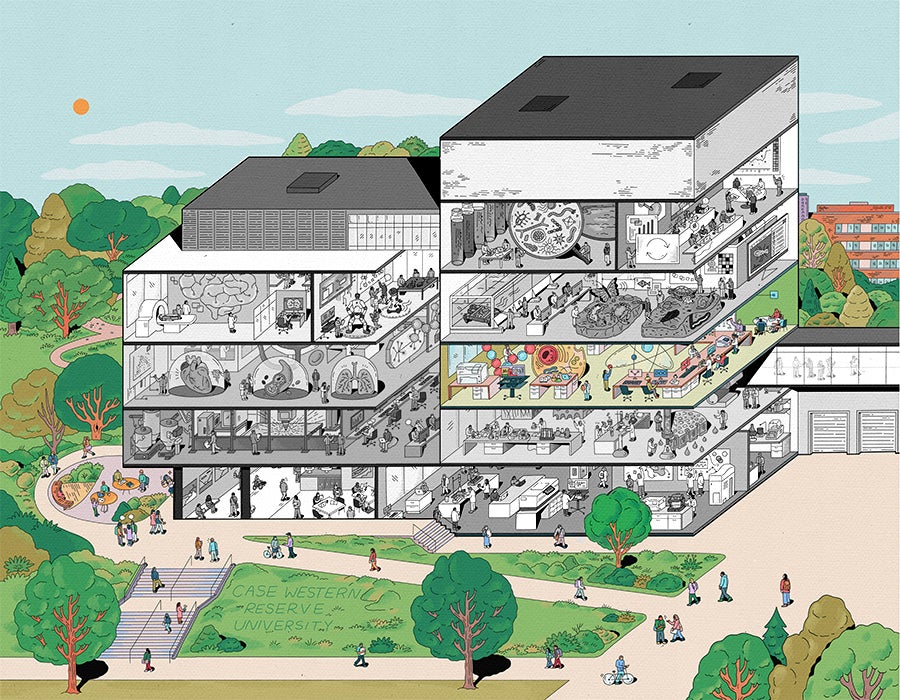
This is the kind of work the Molecular Therapeutics research cluster was designed to advance in Case Western Reserve’s new Interdisciplinary Science and Engineering Building (ISEB). By co-locating researchers from the College of Arts and Sciences and School of Medicine—chemists, pharmacologists, geneticists, and chemical biologists—the cluster aims to move promising ideas from the lab to patients in areas including cancer, immunology and vision.
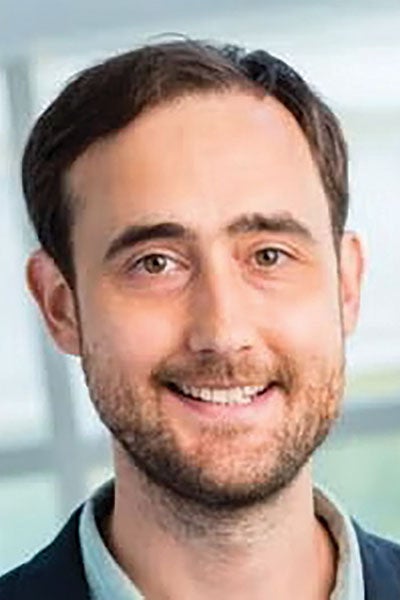
The cluster will be "the beating heart of the academic drug discovery efforts on campus," said Drew Adams, faculty lead for the cluster and professor in the Department of Genetics and Genome Sciences. "If you have ideas, we can help you vet them. If you have projects you want to run, we can help you run them. We're hopeful it becomes a bit of a magnet that gets people coming into the building who have these kinds of therapeutic ideas."
The cluster's experimental capacity will be anchored by the Small Molecule Drug Development Core Facility, a shared resource for researchers in the cluster, across campus and beyond.
Mapping the unknown
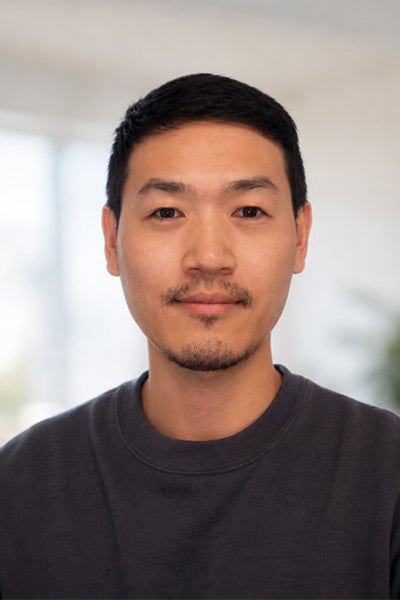
The opportunities and collaborative environment of the ISEB are part of what drew Yongfeng Tao, PhD, assistant professor in the Department of Pharmacology, to the university. He joined the faculty over the summer, drawn by the breadth of the pharmacology department and the ISEB's cluster model, one he hopes can help "spark new ideas, new collaborations, new science, and hopefully new therapeutics."
Tao, whose work sits at the intersection of biology and chemistry, brings a new expertise to the group. He uses specialized techniques to understand the interactions between small molecules and the proteins in human cells.
There are two approaches to identifying targets for drug discovery. In one, they expose a biological sample (cells, tissues, or animals) to a small molecule compound to look for effects, like a compound that kills cancer. But this doesn't identify a specific protein, and figuring that out can take years.
"That is where the problem of target identification is most bottlenecked," Tao said.
The second approach begins with a known protein against which researchers screen different compounds. While more accurate, this limits them to a small fraction of the proteins already validated as drug targets.
Tao's approach sidesteps both issues. He uses a specialized class of molecules called covalent compounds alongside a chemical proteomics technique.
"In one single experiment, we are able to get a comprehensive map of interactions between this compound of interest and essentially all proteins in the cell," he said, noting this is complementary to traditional methods, rather than a replacement. "We want to extend the capacity and explore the unknown, which is very suitable for our role in academia."
It opens the doors to proteins that conventional methods would not be able to reach in a reasonable timeframe. As for which conditions or diseases this may help advance treatments for, Tao doesn't see any limitations.
‘Intellectual adjacency’
Building that critical mass of expertise and housing these investigators under one roof is central to Adams' vision for the cluster. Tao's hire—bringing capabilities the group didn't previously have—is exactly the kind of addition he had in mind. So is the work of Tochtrop, who’s work addressing eye conditions exemplifies the Molecular Therapeutics cluster’s potential.
Tochtrop has spent more than a decade studying an enzyme within the visual cycle, a carefully orchestrated part of the light-harvesting process that establishes the entire basis for how we see. Deep in the back of the eye are cofactors derived from the organic small molecule vitamin A—the kind you get from eating carrots.
Their default molecular structure is bent, but they straighten out when hit with light. When you look directly at the sun or an extremely bright light and can't see for a moment, it's because you've "bleached" all of the vitamin A cofactors straight.
Tochtrop’s team has discovered molecular mechanisms behind the enzyme involved in bending the vitamin A cofactors to restart the visual cycle. The drugs they're researching now would target the cases where that cycle doesn't work—whether that's caused by an underlying condition or age-related macular degeneration.
- Drew Adams, faculty lead for the cluster and professor in the Department of Genetics and Genome Sciences;
- Radhika P. Atit, PhD, professor in the Department of Biology;
- Carlos Crespo, PhD, associate dean for research for the College of Arts and Sciences;
- Berkley Gryder, PhD, assistant professor in the Department of Genetics and Genome Sciences;
- Fu-Sen Liang, PhD, professor in the Department of Chemistry;
- Yongfeng Tao, PhD, assistant professor in the Department of Pharmacology; and
- Gregory Tochtrop, PhD, the M. Roger Clapp University Professor of Arts and Sciences in the Department of Chemistry.
In the ISEB, they’ll benefit from intellectual adjacency, working alongside peers from different departments who have been thinking about similar questions for years, Tochtrop explained.
"You just need that day-to-day collegial interaction to try and sort through problems," he said. "It's going to be a good environment to make drugs, because you have a group of people that have worried about exactly the types of problems that occur during a drug discovery pathway. For example, understanding what common toxicities exist…. What are the next steps to try and see if it's a translatable molecule or not?”
Translating discoveries from bench to bedside is a foundational outcome the Molecular Therapeutics cluster is aiming for, said Adams, who has some experience in this space. He's co-founder and vice president of discovery for Convelo, a CWRU spinout company that focuses on creating regenerative medicine for neurological disorders. It's based on the research of Adams and Paul Tesar, PhD (CWR '03), director of the Institute for Glial Sciences at the School of Medicine.
"We'd love to have more successful spinouts, where technology is leaving Case Western Reserve and going out in the world," Adams said. "And I think the cluster can certainly help that by advising people from the start and by catalyzing good projects."