


School of Medicine
From driving cutting-edge research to bringing medical innovations to market, landing competitive awards and more, the faculty, staff and students at Case Western Reserve University School of Medicine know how to make headlines.

Hero Type
Image
Andrew Pieper receives CWRU’s second eminent professorship
Andrew Pieper, MD, PhD, is tackling some of medicine’s toughest targets: Alzheimer’s, Parkinson's and brain injury. Now, his work at Case Western Reserve University School of Medicine is getting an even bigger boost thanks to alumna and psychiatrist Rebecca E. Barchas, MD (MED ’75). Pieper’s…



In the News



Recent News

April 10, 2019
The annual Nobel Symposium, which was postponed due to cold weather conditions earlier this year, will take place Thursday, April 11, from 4 to 5:30 p.m. in Rockefeller Hall, Room 301. Three CWRU faculty members will describe the achievements of the 2018
Nobel laureates: Alex Huang, professor of…

April 09, 2019
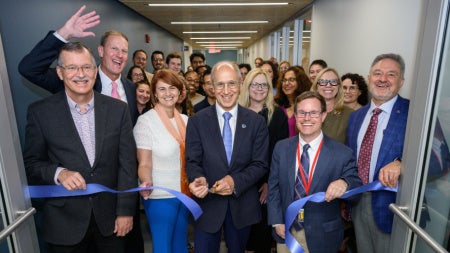
Innovative architectural design and state-of-the-future technology to welcome students from dental, medical and nursing schools Case
Western Reserve University and Cleveland Clinic launched a new era of health
education today in dedicating the centerpiece of their new campus, the Sheila
and Eric…
April 08, 2019
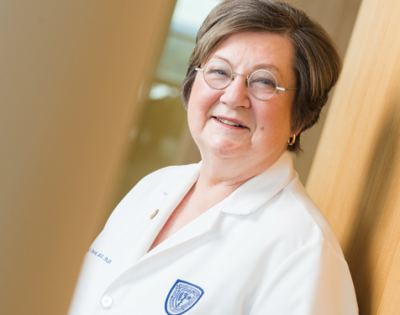
In 2012 we began a new emphasis on moving top flight science from our research labs to patients. This required the help of experts in the commercial sector, new investments by us and others, and a culture change within the School. It had to become exciting and important to develop one’s technology.…
April 05, 2019
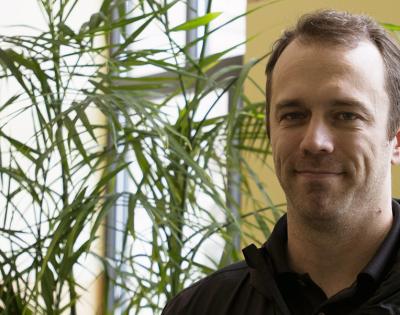
Zechariah “Zack” Jenkins distinctly remembers the moment he
knew he wanted to pursue a new career. Sitting in a bunker with mortars coming
at it while deployed in the Middle East, he realized it just wasn’t what he
wanted to do for the rest of his life. Though he had just signed on for more time…

April 04, 2019
The Case Western Reserve University community is invited to
the inaugural Symposium for the Center for Aerospace Physiology, which is
housed within the Department of Physiology & Biophysics at the School of
Medicine. The symposium will be held April 29–30 from 8:30 a.m. to 5
p.m. in Thwing…
April 03, 2019
March has always been a time of transitions – from winter to spring, from the press of the academic year through spring break to its downhill slope toward commencement, from the promulgation of New Year’s resolutions to settling into what we are actually going to do. For the School, it’s been…
April 02, 2019
Probiotics typically aim to rebalance bacteria populations in the gut, but new research suggests they may also help break apart stubborn biofilms. Biofilms are living microbial communities—they provide a haven for microbes and are often resistant to antibiotics. A new study describes a specific…
April 01, 2019
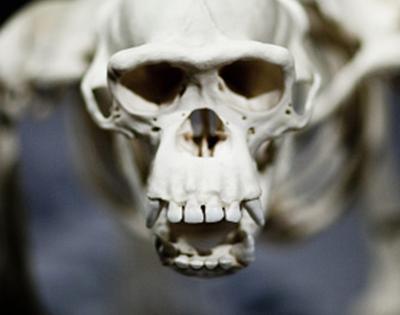
4.5 million-year old fossil shows evidence of greater reliance on bipedalism than previously suggested Fossil hominin talus The oldest distinguishing feature between humans and our ape cousins is our ability to walk on two legs—a trait known as bipedalism. Among mammals, only humans and our…
March 24, 2019
The Cleveland Brain Health Initiative (CBHI), housed at CWRU, includes the Clinic, UH, MetroHealth, the local VA, NEOMED and Kent State University. So far, the initiative has spent a lot of time creating opportunities for collaboration, including a few established discussion groups that meet…