


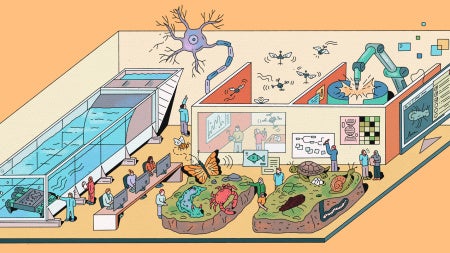
In order to translate these robots from the research lab into real-world environments, the NeuroRobotics boasts facilities capable of recreating challenging environmental conditions alongside the control and instrumentation of a research lab. These include a wave tank and a sandbox, where robots and invertebrates can be tested on a variety of natural surfaces and conditions. The space can be reconfigured to emulate lunar, martian, industrial and medical environments to suit ongoing and future projects. The robots developed in this cluster have a range of anticipated uses. Crab-like robots move hazardous debris to aid in surf-zone cleanup. Worm-like robots will squeeze into tight spaces to maintain infrastructure or search in rubble.
Problems that NeuroRobotics is Working to Solve
What can we learn from animals about intelligence and design of automated robots and cyber physical systems? What can controllable models teach us about how animal intelligence works? These are just a couple of the questions NeuroRobotics is looking to answer.
Explore NeuroRobotics Collaborations
NeuroRobotics News
-
 October 26, 2026Researchers are coming together under one roof with interdisciplinary expertise and advanced tools to act on pressing problems and benefit society
-
 October 20, 2026This is the final story in a nine-part series introducing the research, people and building that will define Case Western Reserve’s next chapter of discovery. Explore the full series to learn about the seven research clusters and the resources that make the work possible.Editor's note: This story…
-
 October 16, 2026How a team of Case Western Reserve researchers is drawing on millions of years of evolution to solve urgent problems with robotics
Contact Us
To learn more about NeuroRobotics, contact cluster faculty lead Kathryn Daltorio or meet the team of researchers.