

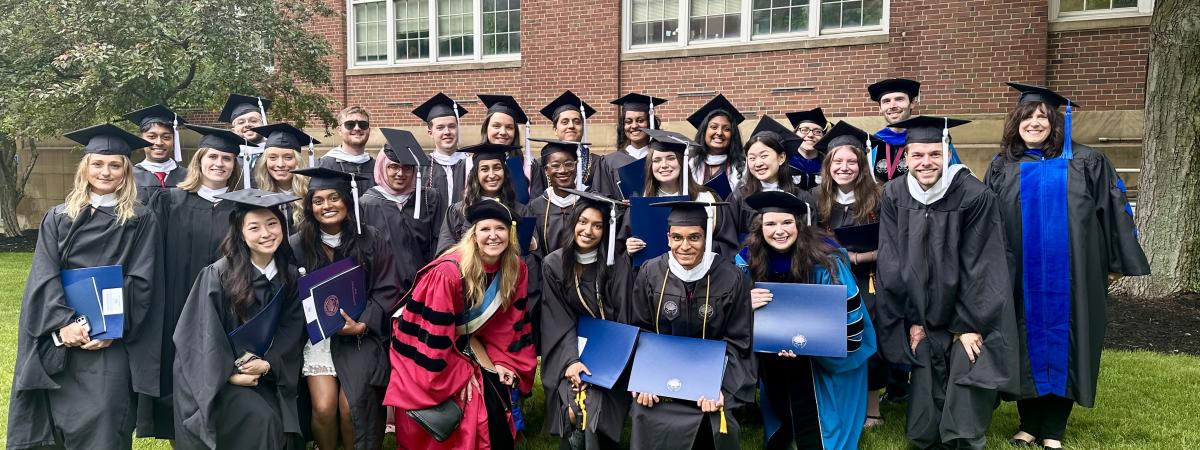
Master's degree and Ph.D. graduates, May 2024
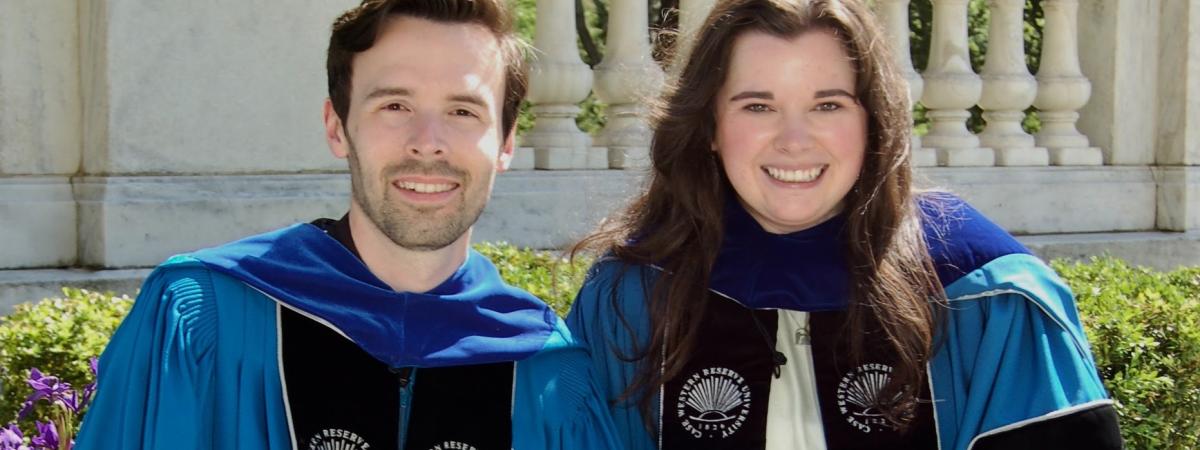
Our most recent Ph.D. recipients! Drs. Eric Blackstone and Anna Goff!
Our Master's and doctoral graduates in bioethics and medical humanities are uniquely equipped to navigate the complex ethical, social, cultural, and historical dimensions of health, illness, and medical practice. They bring a nuanced understanding of moral reasoning and interdisciplinary inquiry to a truly broad range of professional settings.
Across these diverse careers in health, research, academia, non-profits, law, and government, our graduates are united by a commitment to humanizing healthcare and promoting a richer understanding of the social, cultural, and ethical dimensions of medicine.
In it's thirty-one year tenure, the MA in Bioethics and Medical Humanities program has graduated hundreds of students who have gone on to become successful professionals in a variety of fields. Below shows in general, where our alumni have gone on to build their careers.
| Career Field | Roles/Titles |
|---|---|
Practicing Clinicians | Physicians, surgeons, pediatricians, psychiatrists, OBGYNs, neurologists, urologists, dermatologists, nurse practitioners, physician assistants, dentists, genetic counselors, and other licensed clinical providers. |
Research and Academia | Professors, assistant/associate professors, post-docs, research coordinators, research assistants, scientists, clinical researchers, and other university or institute research roles. |
Bioethics & Clinical Ethics | Bioethicists, clinical ethicists, ethics fellows, ethics committee chairs, bioethics PhD students. |
Law & Legal Professions | Attorneys, counsels, legal professionals, law clerks, public defenders, intellectual property litigators, general counsels, and legal nurse consultants. |
Public Health & Health Policy | Public health advisors, health policy analysts, policy researchers, program officers, program analysts, and those at agencies like the NIMH, NCI, or the American Public Health Association. |
Healthcare Administration & Management | Hospital administrators, directors, program managers, clinical quality assurance leaders, compliance officers, operations directors, and similar non-clinical roles in the healthcare field. |
Mental Health & Social Work | Therapists, psychologists, social workers, counselors (drug/alcohol, hospice, lung transplant, pediatric), and behavioral health professionals |
Business and Technology | Healthcare IT consultants, software developers, health AI roles, clinical trial specialists, supply chain analysts, business founders, owners, and managers. |
*Data provided in the table above is based on averages of collected alumni data and does not account for every
Our PhD graduates are leading scholars and educators, securing positions in academic departments, or working with government agencies, think tanks, and non-profit organizations,
Dr. Eric Blackstone defended his dissertation titled "Stakeholder Perspectives on Family Caregiver Involvement in Oncology Clinical Trial Decision-Making" in March 2024. His exceptional work earned him the School of Medicine Department of Bioethics Doctoral Excellence Award, recognizing his outstanding research, scholarship, service, and collaboration.
Prior to his PhD, Eric received his Bachelor of Science in Psychology from The Ohio State University in 2012 and his MA in Bioethics from our department in 2014. While pursuing his doctoral degree, he concurrently worked full-time as a Research Associate with Dr. Susan Mazanec in the Frances Payne Bolton School of Nursing at Case Western Reserve University.
Eric's dissertation explored the perspectives of family caregivers and clinical trial staff in oncology clinical trial decision making. Through focus groups and semi-structured interviews, he discovered that caregivers view their role as supporting patient understanding and deferring to the patient as the final decision maker, while trial staff relied on caregivers to help patients understand information and adhere to the study protocol. His research highlights the importance of early communication with caregivers and the need for training clinical trial staff on best practices for caregiver inclusion.
In addition, Eric secured NIH funding for his dissertation work as a supplement to Dr. Mazanec's R37 grant. His dissertation committee consisted of Drs. Sana Loue (Chair), Mark Aulisio, Barbara Daly, and Jennifer Dorth.
Following his PhD, Eric began a postdoctoral fellowship at Dana-Farber Cancer Institute, where he continues his groundbreaking work in bioethics and oncology research.
Dr. Anna Goff, PhD, MA
Dr. Anna Goff completed her PhD in March 2024, defending her dissertation titled "The Clinical Ethicist's Scope of Practice: Expectations, Experiences, and Emotions."
Anna holds a BA in Chemistry and an MA in Bioethics & Medical Humanities from our department. During her doctoral studies, she served as a Clinical Ethics Intern at The MetroHealth System in Cleveland, OH, and gained teaching experience at various academic levels.
Her dissertation, based on interviews with 34 clinical ethicists in the United States, introduces the concept of secondary moral distress to describe the emotional impact of assuming a therapeutic role in morally distressing situations. Her dissertation committee consisted of Drs. Monica L. Gerrek, Marsha Michie, Mark Aulisio, Oliver Schirokauer, and Esther I. Bernhofer.
Anna's research interests include clinical ethics, moral distress, and end-of-life ethical issues. She has been involved with MetroHealth's Institute of Burn Ethics since 2018, and joined the American Burn Association's Ethical Issues Committee in 2023.
Following her PhD, Anna began a Clinical Ethics Fellowship at Weill Cornell Medicine in New York City.