From ideas to breakthroughs: Explore the shared instruments and collaboration spaces in CWRU's new Interdisciplinary Science and Engineering Building
This is the final story in a nine-part series introducing the research, people and building that will define Case Western Reserve’s next chapter of discovery. Explore the full series to learn about the seven research clusters and the resources that make the work possible.
Great ideas ignite when disciplines and sectors intersect. Michael Oakes, PhD, calls these moments social collisions: unplanned interactions, like when a chemist meets an engineer in the coffee line.
In the new Interdisciplinary Science and Engineering Building (ISEB)—equipped with advanced instrumentation, shared resources and experts to run them—sparks will have the chance to become breakthroughs.
"A social collision is only the start. The real payoff comes when two people with different questions walk down the hall and find the instrument that lets them test the idea that same week," said Oakes, Case Western Reserve University’s executive vice president for research and economic development. "We designed the ISEB so the conversation and the capability sit side by side."
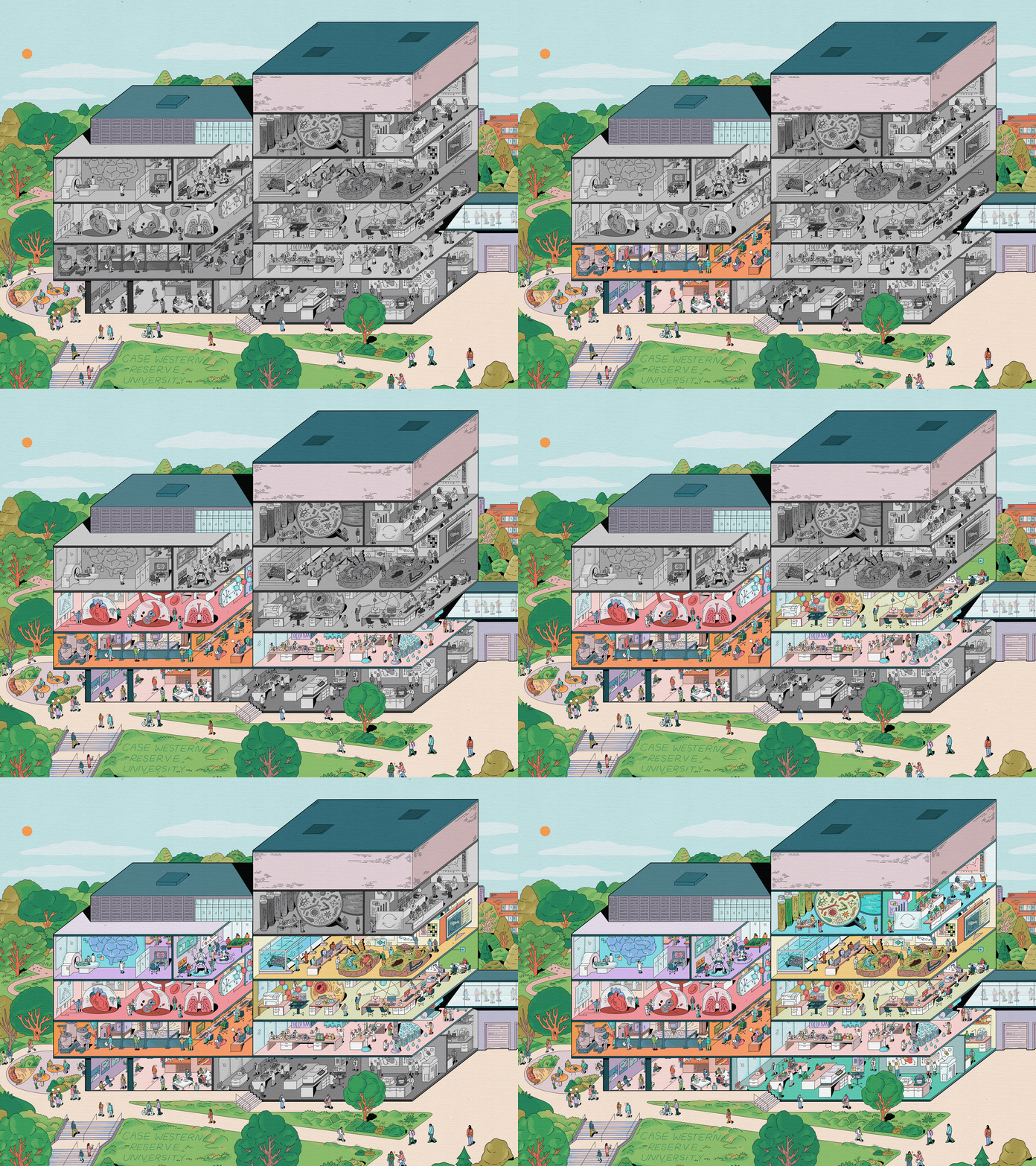
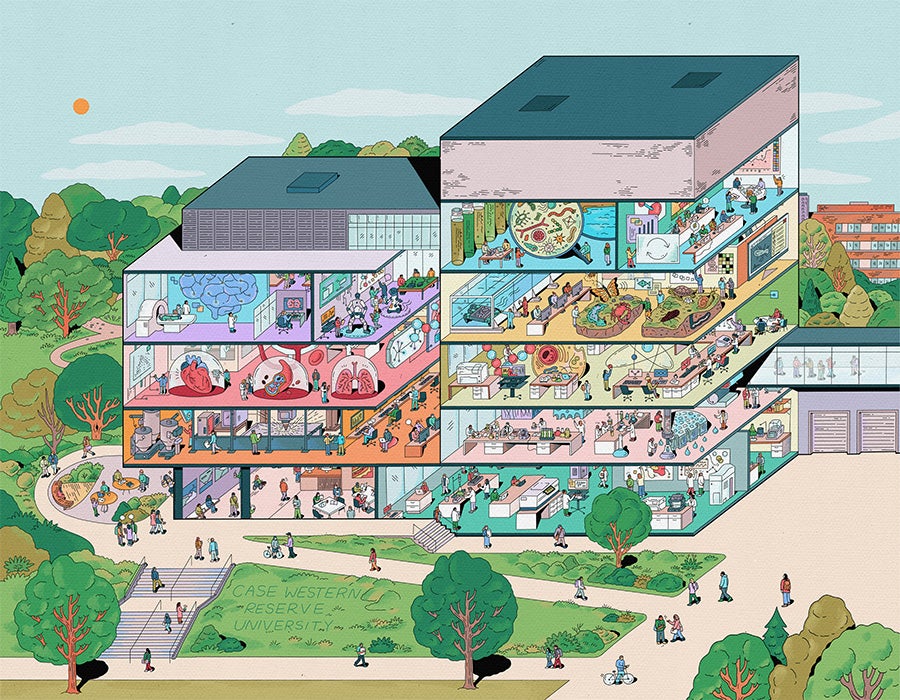
The ISEB is organized around seven research clusters to tackle complex research challenges that don't fit neatly into a single lab or field—challenges including improving energy storage, restoring movement, developing new treatments, tracking algal blooms and designing new materials.
Beyond these clusters, the building’s ground floor offers 7,000 square feet of space for a new, central home for several "core facilities." These are instruments and equipment available to campus researchers and external partners—anyone with a question worth testing. Additional core facilities will be housed within a few related clusters, bringing the total space dedicated to core facilities in the ISEB to 11,000 square feet.
"We want folks to know that we are here, and that we are able to help with their science," said Frank Tedeschi, director of core services for the School of Medicine.
Cross-cluster collaborations
Already, researchers are starting to think about how their equipment—whether within cores or in their new shared labs—might benefit their colleagues across clusters in the new space.
For instance, Svetlana Morozova, associate professor in the Department of Macromolecular Science and Engineering, sees a number of possible partnerships with her cluster, Advanced Materials & Manufacturing, in which researchers aim to discover, develop and improve materials and the processes used to make them.
"Everybody uses materials," Morozova said, "so we can make materials for the NeuroRobotics cluster, or for the [James M. Galm, PhD, PE Electrochemical Engineering & Energy Science] cluster next door or for the Precision Diagnostics & Therapeutics cluster."
Samuel Root, PhD, a member of the NeuroRobotics cluster, is exploring ways to automate time- and labor-intensive steps in materials research. Developing new polymer formulations, for example, often requires researchers to manually weigh and mix reagents, carry out chemical reactions, and characterize the resulting materials—a process that can take days and involve substantial hands-on manipulation.
In addition to 7,000 square feet of the ISEB’s ground floor being dedicated to shared core research services and equipment space, four clusters will offer cores within their footprints:
- The James M. Galm, PhD, PE Electrochemical Engineering & Energy Science cluster will include a satellite location for the Electrochemical Design Center (EDC).
- The Advanced Materials & Manufacturing cluster is working to stand up a core facility to provide shared access to instrumentation.
- The Molecular Therapeutics cluster includes space for the Small Molecule Drug Development core facility.
- The NeuroTechnology cluster recently launched the Neural Imaging and Histology Core.
Root, an assistant professor in the Department of Macromolecular Science and Engineering, is investigating human-in-the-loop, AI-enabled approaches to accelerate materials design by systematically screening how chemical formulations influence material properties and performance.
"It's becoming easier than ever to connect laboratory instruments and automate experiments because AI agents can help bridge different instrument interfaces and write the Python scripts needed to control them," said Root. "Imagine preparing hundreds of material formulations in small vials or wells, and then using laser-based imaging or indentation to measure their mechanical properties. By automating these experiments, we can explore a much larger range of materials and ask questions that were previously impractical, while freeing researchers to scale up the most promising formulations and investigate their properties in greater depth."
That work could benefit the research of his fellow cluster members in NeuroRobotics, as well as those in other ISEB clusters, including Advanced Materials & Manufacturing.
Chris Wirth, PhD, Advanced Materials & Manufacturing faculty lead, is working on a project studying the effect of microplastics on the body in collaboration with Andrew Shoffstall, PhD (GRS '13, biomedical engineering), the Nord Distinguished Associate Professor in the Department of Biomedical Engineering.
"In our cluster, we have lots of tools to characterize microplastics in the context of this grant," said Wirth, associate professor in the Department of Chemical and Biomolecular Engineering, "and [Shoffstall] has tools to probe what that does to your body."
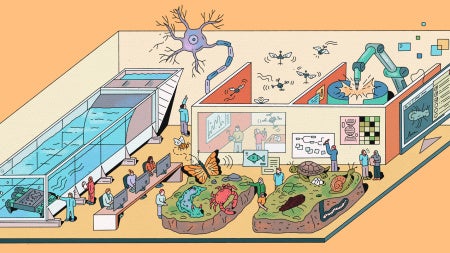
Multiple researchers expressed interest in the techniques and tools within the Climate & Ecosystem cluster. Drew Adams, PhD, faculty lead for the Molecular Therapeutics cluster and professor in the Department of Genetics and Genome Sciences, was among them. Though his research approaches small molecules in a different way than the climate groups, they use similar tools and instruments.
"I think it'll be an interesting experiment,” Adams said, “just bringing people and their toys together to see what impactful work can be done.”
Inside the ISEB
Humanities
In addition to advanced instrumentation, the ISEB also integrates the humanities. The third floor, the Eric & Jane Nord Family Floor, features collaboration space for CWRU’s Baker-Nord Institute for the Humanities and includes the new Jack, Joseph and Morton Mandel Experimental Humanities Hub, an interactive area for humanities, arts and technology.
The integration leans into the university's history of collaboration. In 1967, the newly federated Case Western Reserve University became an official entity, solidifying a partnership between the science and engineering powerhouse Case Institute of Technology and the liberal arts pillar Western Reserve University.
"It's really about tapping into what's special about this place, which has to do with its, to me, wonderfully weird hybrid identity as the offspring of a marriage of an engineering school and a traditional college," said Timothy Beal, PhD, a Distinguished University Professor, the Florence Harkness Professor of Religion and faculty lead of Experimental Humanities.
CWRU already has many students who double-major in neuroscience and philosophy or study robotics and dance, and Beal wants to develop programming and research support to enable more integrative work for the range of interests. He envisions a flexible space that could host a performance in the morning and a hackathon later in the day.
Industry partnerships
From startups to multinational corporations, companies already bring problems to CWRU's cores. In the ISEB, they’ll gain a front door to enhanced efficiency and cost savings.
Companies exploring new directions or products can turn to the university's shared research resources to try a new instrument before buying one, while small companies may do a lot of their essential work using core facilities.
The goal is to have industrial research become a larger part of core facilities' portfolio, said Ina Martin, PhD, CWRU’s executive director of research cores and infrastructure. The ISEB provides a visible, easy-to-find centralized space for the shared resources to enhance corporate engagement at every level. It can also help bolster applications for instrumentation grants.
"This is the best possible space for facilities," Martin said. "If you can tell a funding agency, 'I have 100 users lined up, 30 external partners, staff to run it and the best engineered space in the region to put it'—you've got a higher chance for success."
Whenever a lab seeks to expand its capabilities with a new instrument—especially ones with high price tags—Tedeschi said, three questions come first: "Who's going to use it? Where are you going to put it? And who's going to run it?" With the ISEB, he said, "we have answers to all three of those."