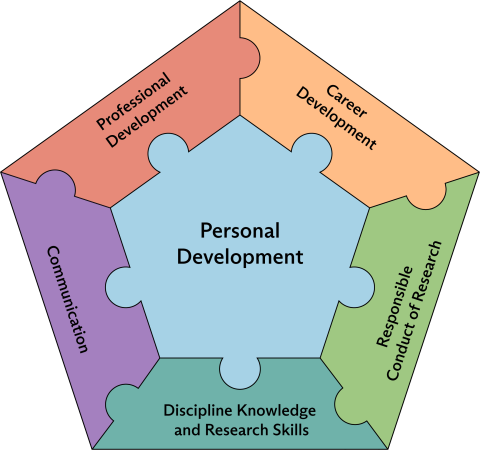
The CWRU School of Graduate Studies Core Competencies articulate the scholarly, professional, and personal skills required for success in today’s diverse career landscape. These competencies are aligned with national and international best‑practice frameworks, including recommendations from the National Academies of Sciences, Engineering, and Medicine; the NIH Broadening Experiences in Scientific Training (BEST) initiative; the Association of American Universities; the Council of Graduate Schools; and the Vitae Researcher Development Framework. These competencies were developed in consultation with industry partners who actively hire CWRU master’s and doctoral graduates and reflect skills and experiences valued across academic, industry, nonprofit, and public sectors. They serve as a shared roadmap for students and faculty to support intentional mentoring, self‑reflection, and professional growth while complementing discipline-specific training. The competencies are not a metric by which students should be graded, but rather are intended to empower students to take ownership of their preparation for meaningful and impactful careers.
Listed below are the recommended core competencies and associated learning objectives that doctoral graduate students should demonstrate by the time of program completion to promote future career success.
Apply disciplinary knowledge, technical expertise, and critical thinking skills to design, conduct, and interpret original research.
- Intellectual Agency and Project Ownership: Cultivate intellectual agency as a scholar, demonstrated through expert-level disciplinary knowledge, critical thinking, curiosity, and ownership of the thesis project.
- Advanced Technical Skills and Expertise: Demonstrate technical skills necessary for making original contributions to the field.
- Identification of Research Questions for Exploration: Apply knowledge of the field to develop research questions.
- Synthesis of Knowledge and Research Design: Apply knowledge of the field to develop research plans to answer unsolved questions.
- Interpretation of Research Findings: Interpret and critically assess the results of research to form conclusions.
- Critical Assessment of Research Conclusions: Critically evaluate and/or experimentally test alternative interpretations of results and the conclusions of others.
Conduct research and scholarship with ethical integrity and accountability.
- Personal Academic and Research Integrity: Demonstrate a commitment to scientific and scholarly integrity, research ethics, and the responsible conduct of research.
- Ethical Research Accountability: Uphold high ethical standards and contribute to a culture of ethical accountability.
- Sensitivity to Ethical Issues: Understand and possess sensitivity to ethical issues surrounding the conduct of research by scholars with diverse backgrounds.
- Responsible and Ethical Decision Making: Demonstrate the ability to make responsible choices when faced with ethical dilemmas in research.
- Ethical Research Practices: Utilize acceptable practices for conducting research within the field.
Communicate effectively with diverse audiences across scholarly, professional, and public-facing contexts.
- Scholarly Oral Communication: Demonstrate proficiency in oral communication of research to scholars in the field, scholars outside of the field, academic-adjacent audiences, and the lay community.
- Scholarly Written Communication: Demonstrate a proficiency in written communication of research to scholars in the field, scholars outside of the field, academic-adjacent audiences, and the lay community.
- Professional Oral Communication: Demonstrate a proficiency in oral communication of accomplishments and experiences with others for the purpose of networking and career enhancement.
- Professional Written Communication: Demonstrate a proficiency in written communication of accomplishments and experiences with others for the purpose of networking and career enhancement.
- Communication Style Adaptation: Recognize the difference between formal and informal communication and tailor communication style appropriately for the environment.
- Giving and Receiving Feedback: Demonstrate the ability to thoughtfully give constructive feedback as well as to receive, evaluate, and incorporate feedback provided by others.
Engage in intentional career exploration and planning informed by self-reflection and goal-setting.
- Value of Career Development: Recognize the importance of career exploration and career development as a critical step for career planning and advancement.
- Self-Reflection and Goal Setting: Develop measurable career goals to guide career success based on recurring self-assessments of values, skills, interests, and career motives.
- Career Exploration: Demonstrate a commitment to career exploration and development by seeking out and evaluating key resources and opportunities tailored to career aspirations.
- Value of Experiential Learning: Seeks out opportunities to explore career paths and build competencies through experiential learning.
- Career Development Plan: Develop and evolve a career development plan to achieve career goals and aspirations.
- Career and Job Market Success: Develop, showcase, and apply key skills gained to promote success in the current and future job markets and careers.
Develop leadership capacities, professionalism, and collaborative skills necessary for success in diverse work environments.
- Professional Interactions: Demonstrate self-awareness and respect for professional norms while recognizing that expectations may vary across cultures and contexts.
- Leadership and Teamwork: Demonstrate an ability to collaborate, lead, lead by example, and be led by others.
- Interdisciplinary Skills: Demonstrate collaborative skills necessary to promote the achievement of common team goals in interdisciplinary settings.
- Management Skills: Demonstrate an ability to manage people, projects and activities with respect to effort, time and execution.
- Broad Perspectives in Team Success: Recognize and value diversity of perspectives and backgrounds as an important element to building and maintaining interdisciplinary relationships and collaborations.
- Commitment to Professional Development: Demonstrate a commitment to professional development as a lifelong process by seeking out and evaluating key resources and opportunities tailored to professional aspirations.
Cultivate resilience through self-awareness and self-care to support long term success and mitigate burnout.
- Work-Life Integration: Demonstrate and value a personally-sustainable approach to balancing personal and professional lives, obligations, and relationships.
- Stress Management: Demonstrate the ability to routinely manage stressors effectively to ensure obligations are met within reason.
- Ability to Seek Help: Demonstrate the ability and willingness to seek out support, resources, and mentorship when needed
- Self-confidence: Develop confidence in one’s ability as a scholar and a professional while recognizing and addressing the contributors to imposter syndrome where possible.
- Well-being: Understand the importance of caring for oneself and practice strategies to promote resilience.
- Success and Personal Development: Understand the important role of personal development and well-being in the ability to achieve professional goals.