

📅 Date: Friday, October 2, 2026
🕒 Start Time: 4:00 PM
📍 Location: Harkness Chapel, Classroom
👥 Who: Free | Open to the public
About The Series
Our weekly Friday colloquia showcase current research by distinguished visiting scholars alongside our own faculty and graduate students in musicology, historical performance practice, and music education. A brief reception follows each talk to keep the conversation going. All are welcome!
About The Talk
“Alpha Groove”
“Everyone has a little electronic studio inside his or her brain”—so suggested Alvin Lucier in a 1971 interview with Douglas Chambers. He made the comment in connection with his Music for Solo Performer, a landmark work in which signals from the human brain were captured, electronically amplified, filtered, and rendered audible via sympathetic vibration. The process was both medical and mystical: an electrical circuiting of neural and musical frequency such that that inner and outer vibration appeared to be continuous. And yet, for Lucier, Solo Performer was less a ‘sound idea’ than an experiment in ‘control’ and ‘attention’ arising from what he termed ‘a perfectly meditative alpha state.’ Here, I unpack the assemblage of technologies and sound ideologies that produced these claims, situating Solo Performer in a long-arc history of neural sonification extending back to the 1930s and forward through more elaborate sound-mind syntheses of the 1970s, including those of David Rosenboom. I am particularly interested in ‘alpha’ frequencies, which exercised a curiously powerful influence across the fields of experimental psychology, physics, philosophy, music, and aesthetics. Laying special claim to the domain of the sonic, alpha stood at the center of a new neural acoustemology that made listening an index of volition and consciousness itself an auditory technique.
About The Speaker
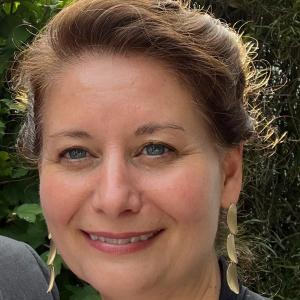
Francesca Brittan is a scholar of nineteenth-century music and aesthetics. She holds a Ph.D. from Cornell University (2007), and was a Research Fellow at Queens’ College, Cambridge between 2006-08. She joined the faculty at Case in 2009. Her current research and teaching interests include music and histories of magic, intersections between sound and romantic science, nineteenth-century orchestral and conducting cultures, and sonic histories of mind. Brittan also works on popular music, especially blues and early rock and roll.
Brittan has been the recipient of numerous grants and awards, including a Governor General’s Award, a Sage Fellowship (Cornell University), a Sicca-Manon Fellowship, a SSHRC Postdoctoral Fellowship, a Junior Research Fellowship (University of Cambridge), a Glennan Fellowship (CWRU), and a W.P. Jones Presidential Faculty Development Award (CWRU). In 2012, she won the American Musicological Society’s Alfred Einstein Award.
In addition to her scholarly activities, Brittan is active as fortepianist and teacher of eighteenth- and nineteenth-century performance practices. She was trained at the Royal Conservatory in the Hague (Bart van Oort and Patrick Ayrton) and Cornell University (Malcolm Bilson) and has received several international grants for performers, including the Chalmers Award. She is particularly interested in late-eighteenth- and early-nineteenth-century melodrama and related traditions of romantic declamation, and, in recent years, has given a series of performances showcasing this material in Europe and North America. She is also on faculty at the Cleveland Institute of Music.
Venue Information
Harkness Classroom, located inside Harkness Chapel, serves as both a lecture hall for large classes and a backstage area during events. It is also the meeting location for the CWRU Music Colloquium Series.
Health + Safety
The health and well-being of our community is important to us as we gather for campus events. University Health and Counseling Services provides up-to-date guidance and resources to help support a safe campus experience. For life-threatening emergencies, please call CWRU Public Safety immediately at 216.368.3333.