

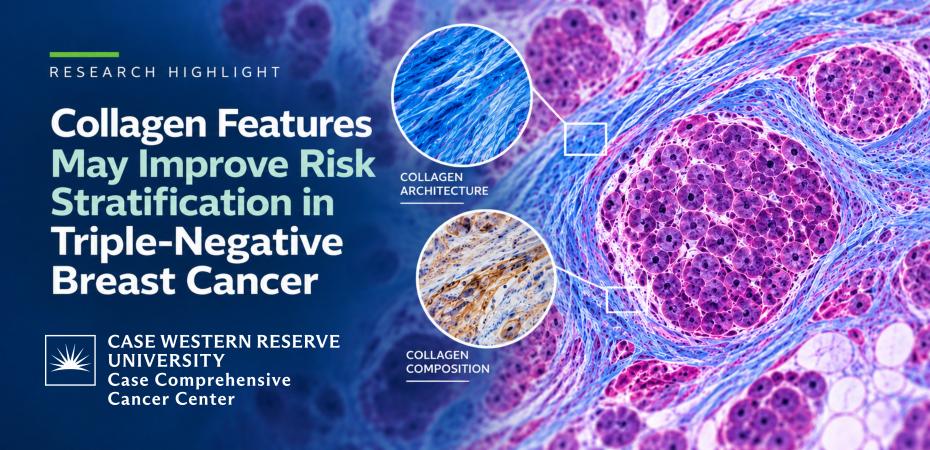
Patients with triple-negative breast cancer (TNBC) can experience markedly different outcomes despite having similar clinicopathologic features.
New research generated by Case CCC members at Cleveland Clinic suggests that characteristics of the tumor extracellular matrix—specifically collagen architecture and composition—may provide additional prognostic information.
The study, Integrated collagen architecture and composition improve risk stratification in triple-negative breast cancer, by Molecular Oncology Program members Mihriban Karaayvaz, PhD, and Ruth Keri, PhD, Case CCC Associate Director for Basic Research; and Cancer Imaging Program member Murat Yildirim, PhD, was published in Neoplasia.
The team analyzed tumors from 79 patients with TNBC using a multimodal computational pathology approach combining Masson Trichrome staining with COL1 and COL3 immunohistochemistry.
Fiber-based image analysis and unsupervised clustering identified distinct patterns of intratumoral collagen architecture, while collagen composition was measured using the COL3:COL1 ratio.
Four collagen architectural states emerged and were consolidated into low- and high-risk groups based on recurrence patterns. High-risk architecture was associated with a significantly shorter recurrence-free interval. Independently, a higher COL3:COL1 ratio was associated with improved overall survival.
Combining the two measures further sharpened risk stratification: patients with high-risk collagen architecture and a low COL3:COL1 ratio had the poorest outcomes.
Importantly, these collagen-defined phenotypes distinguished patients with divergent outcomes that were not readily apparent from tumor stage alone.
The findings support extracellular matrix phenotyping as a potentially practical computational pathology strategy for refining TNBC risk assessment beyond conventional clinicopathologic measures.
The research received both a Case Comprehensive Cancer Center JumpStart Grant and support from the NCI Cancer Center Support Grant (P30CA043703).