

Academic Requirements
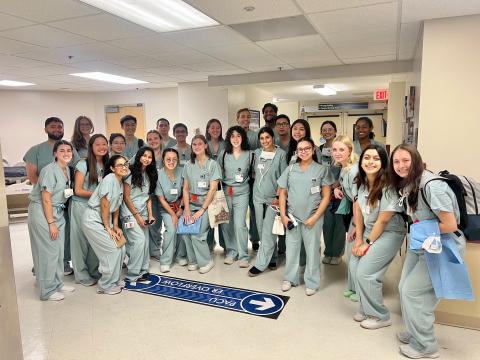
The mission of the Master of Science in Anesthesia program is to graduate skilled and compassionate anesthetists. The admission policy reflects this goal. Applicants are considered on a variety of parameters that measure academic ability, interpersonal skills, clinical aptitude, and qualities such as professionalism, empathy, and leadership ability. It does so without regard to race, religion, age, sex, color, sexual orientation, national or ethnic origin, or political affiliation.
Admission to the MSA program requires that the following criteria are met. No exceptions will be made for required prerequisite coursework or the admissions tests, regardless of degrees or certification received, prior experience, work background, or education.
1. Bachelor's degree from an accredited college or university
Applicants for admission must complete a course of study leading to a baccalaureate degree at an accredited United States, U.S. territory, or Canadian college or university, or its equivalent, prior to matriculation. We do not accept online degrees.
2. Prerequisite courses
Documentation of each of the prerequisites having been completed at an accredited United States, U.S. territory, or Canadian institution of higher learning is required.
Course substitutions are not permitted, and survey courses for non-science majors are not acceptable.
Use the CWRU MSA Prerequisite Worksheet form for assistance in organizing your prerequisite courses.
- one semester of biochemistry: advanced course preferred. Avoid blended biochemistry courses, such as a biochemistry/organic chemistry course. Bioengineering courses will not fulfill this requirement.
- one year of biology with lab: a year-long introductory biology course sequence with lab for science majors. Bioengineering courses as well as courses in micro- or molecular biology, cellular biology, genetics or histology will not fulfill this requirement.
- one semester of human anatomy with lab: advanced course preferred. Courses in comparative vertebrate anatomy, embryology, neuroanatomy, or developmental anatomy will not fulfill this requirement.
- one semester of human physiology: advanced course preferred. Courses in mammalian physiology or embryology will not fulfill this requirement.
- one year of chemistry with lab: a year-long introductory chemistry course sequence with lab for science majors.
- one semester of organic chemistry with lab: one semester of organic chemistry with lab is required. A second semester with lab is preferred but not required.
- one year of physics with lab: a year-long introductory physics course sequence with lab for science majors. This can be either algebra- or calculus-based physics.
- one semester of calculus: precalculus and calculus survey courses will not fulfill this requirement.
- one semester of advanced statistics: preferably with applications to life or health sciences, and preferably with a calculus I prerequisite. Elementary or basic courses will not fulfill this requirement. AP Statistics will not fulfill this requirement.
- one semester of English with expository writing: can also be fulfilled with other expository writing courses in the humanities. Science courses with extensive writing components can fulfill this requirement as well.
Notes on Prerequisites
- Prerequisite time limits: Our three key prerequisites - biochemistry, human anatomy with lab, and human physiology - must be taken within 5 years of the application deadline. All other prerequisites must be taken within 7 years of the deadline. These time limits will be waived with an MCAT score of 500 or higher, provided the test was taken within 3 years of the application deadline. A high MCAT score indicates your knowledge of the coursework is still current, and we do not ask that you retake your older coursework. Taking the GRE will not waive prerequisite time limits.
- Incomplete prerequisites: You may apply with a few prerequisite courses in progress, but all prerequisite courses must be completed before matriculation.
- AP Credit: The program no longer accepts AP Statistics to fulfill the advanced statistics prerequisite. AP credit may still be used for other prerequisite courses if the following criteria are met: a score of 4 or 5 on the AP exam and a grade of B- or higher in the corresponding high school AP course. Please note that AP credit for Biology, Chemistry, and Physics may only be applied toward one semester of prerequisite coursework, regardless of the amount of undergraduate credit awarded. Applicants using AP credit for prerequisites must submit both their AP score report and high school transcript through the Documents section in CASAA.
- Combining prerequisites: A one-semester human anatomy and physiology course with lab satisfies both the human anatomy (with lab) and human physiology prerequisites. You may complete these requirements separately or as a combined course. No other prerequisites may be combined.
- Proof of labs: If a lab was included in a course but is not listed on your transcript as a separate course, you must provide proof that the lab was completed. An official course description from your institution's website showing that a lab was included with the course will be sufficient. You can upload lab backup on the Documents page in CASAA.
3. GRE or MCAT assessment
The MSA program requires either the MCAT or the GRE as part of the holistic application review. The MCAT or the GRE must be taken within three years of the application deadline. When an applicant has taken the MCAT or GRE more than once, component scores will not be combined. If an applicant has taken both admissions tests, they should submit both official scores for review. For the GRE, the program recommends achieving scores at or above the 60th percentile in the Verbal and Quantitative Reasoning sections, along with a minimum score of 4.0 in the Analytical Writing section. For the MCAT, the program recommends achieving a score of 500 or higher.
2025-2026 Average CWRU MSA Program Matriculant MCAT and U.S. DO and MD Medical Schools
| MCAT | CWRU MSA Middle 80% | CWRU MSA | U.S. DO Medical Schools | U.S. MD Medical Schools |
|---|---|---|---|---|
| Total* | 501-511 | 506 | 503 | 512 |
COM matriculant data taken from AACOM, Applicant and Matriculant Average MCAT 2016-2024
MD matriculant data taken from AAMC Table A-16
*Values are rounded
2025-2026 CWRU MSA Program Matriculant GPA and U.S. DO and MD Medical Schools
| GPA | CWRU MSA Middle 80% | CWRU MSA | U.S. DO Medical Schools | U.S. MD Medical Schools |
|---|---|---|---|---|
| Overall | 3.42 - 3.95 | 3.73 | 3.61 | 3.81 |
| Prerequisites | 3.47 - 3.75 | 3.75 | 3.54 | 3.75 |
COM matriculant data taken from AACOM, Applicant and Matriculant Average GPA 2016-2024
MD matriculant data taken from AAMC Table A-16
2025-2026 CWRU MSA Program Matriculant GRE
| GRE Score | Middle 80% | Average |
|---|---|---|
| Verbal Reasoning | 154-165 | 159 |
| Quantitative Reasoning | 156-165 | 161 |
| Analytical Writing | 4.0-5.0 | 4.3 |
CWRU MSA Program Three-Year Average (2022 - 2025)
| MCAT | GPA Overall | GPA Prerequisite | GRE Quantitative Reasoning | GRE Verbal Reasoning | GRE Analytical Writing |
|---|---|---|---|---|---|
| 506 | 3.76 | 3.75 | 159 | 158 | 4.4 |
4. Casper assessment
Acuity Insights offers admission assessments that give each applicant the opportunity for programs to get to know them better. Casper is an open-response, situational judgment test that evaluates aspects of your social intelligence and professionalism such as ethics, empathy, problem-solving, and collaboration. Casper will assess non-cognitive skills that we believe are important for successful students in our program. The Casper assessment will complement the other tools we use to review applications and will further enhance fairness and objectivity in our review and selection process.
To complete Casper, visit https://acuityinsights.app/. You will register for the United States Casper 2 test (CSP-20100) for the Anesthesia program.
We encourage you to take advantage of the practice test, which will not only immerse you in the test environment but will also ensure you meet the technical requirements to access and complete the test.
We recommend that you complete the Casper assessment before or concurrently with the submission of your application (but no later than November 12, 2026) to ensure there is no delay in the review of your application. Your application will be considered complete only after all components of the CASAA application and your assessment results have been received. If you are a reapplicant, you will need to take a new Casper assessment.
Applicants can select one of the available test dates below (all times are reflected in EST/EDT). All scores must be distributed by November 26, 2026.
The program recommends that applicants applying for the priority review deadline should plan to take the Casper assessment no later than September 15 to ensure their results are distributed by the deadline and that their application can be considered complete.
Join live Casper Office Hours hosted by Acuity Insights to learn more about Casper, understand recent updates, and ask general questions to help you feel prepared and informed.
| Casper Test Dates for 2026-2027 Cycle | Start Time |
|---|---|
| March 19, 2026 | 8:00 pm |
| March 31, 2026 | 8:00 pm |
| April 30, 2026 | 8:00 pm |
| May 14, 2026 | 8:00 pm |
| May 28, 2026 | 6:00 pm |
| May 28, 2026 | 8:00 pm |
| June 9, 2026 | 6:00 pm |
| June 9, 2026 | 8:00 pm |
| June 25, 2026 | 6:00 pm |
| June 25, 2026 | 8:00 pm |
| July 7, 2026 | 6:00 pm |
| July 7, 2026 | 8:00 pm |
| July 19, 2026 | 1:00 pm |
| July 19, 2026 | 4:00 pm |
| July 30, 2026 | 6:00 pm |
| July 30, 2026 | 8:00 pm |
| August 11, 2026 | 6:00 pm |
| August 11, 2026 | 8:00 pm |
| August 25, 2026 | 6:00 pm |
| August 25, 2026 | 8:00 pm |
| September 15, 2026 | 6:00 pm |
| September 15, 2026 | 8:00 pm |
| September 27, 2026 | 4:00 pm |
| October 20, 2026 | 8:00 pm |
| October 27, 2026 | 8:00 pm |
| November 12, 2026 | 6:00 pm |
Shadowing Requirements
The MSA program strongly recommends shadowing a certified anesthesiologist assistant in the operating room environment for 16 or more hours. If you are in an area where CAAs are not prevalent, then shadowing an anesthesiologist or nurse anesthetist practicing within the anesthesia care team model is suggested. Use the MSA program's shadowing form to keep a detailed record of your shadowing hours so that you may upload that document to your CASAA application.
Applicants may request a shadowing experience by contacting their preferred site location directly. While requests can be made at any program location office, the procedures may differ according to affiliate hospital regulations. The program tries to accommodate as many applicants as possible, and requesting a shadowing experience in no way implies or guarantees placement.
Physical and Technical Requirements
As outlined in the Master of Science in Anesthesia Program’s Non-discrimination Policy, each MSA student must possess general abilities required of most healthcare practitioners, and specific abilities that relate more directly to the practice of anesthesia. Essential requirements include, but are not limited to, the following:
- motor skills: physical dexterity to master all technical and procedural aspects of patient care, and adequate motor capability to perform complex two-handed tasks.
- sensory abilities: ability to gather all relevant information about a patient’s physical and psychosocial status with all five senses, especially sight, hearing and touch.
- intellectual abilities: must have sufficient powers of intellect to acquire, assimilate, integrate and apply information; must have the intellectual ability to solve problems.
- communication skills: must have sufficient use of speech, hearing and vision to communicate effectively with patients, teachers and peers in both oral and written forms.
- professionalism: must exhibit professional behavior, including the ability to place others’ needs ahead of your own; display compassion, empathy, altruism, integrity, responsibility and tolerance. Must possess the ability to exercise the requisite judgment in the practice of anesthesia.
- physical health: must possess the physical health and stamina needed to carry out the program of AA education.
A disability does not preclude a student from admission, and the MSA Program makes reasonable accommodations for students with documented disabilities. However, each enrolled student is expected to demonstrate, without unreasonable dependence on technology or intermediaries, the skills and attributes outlined in the program’s Physical & Technical Requirements policy.
Transfer Admission
The primary responsibility of the MSA Program is to offer anesthesiologist assistant training to any person who meets the admission requirements and is accepted into the program. However, program format and enrollment constraints typically do not permit the acceptance of transfer applicants. Typically, the MSA program does not allow students to transfer within Case Western Reserve University programs; however, they may be considered under special circumstances.
Advanced Placement
Advanced Placement within the MSA curriculum — exceptions are rarely made for required coursework or the admissions test, regardless of degrees or certification received, prior experience, work background, or education.