

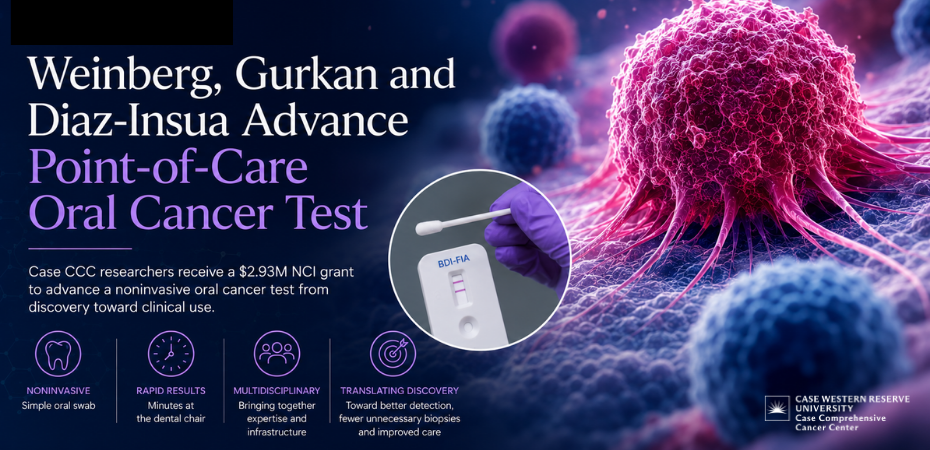
A team of Case CCC researchers has received a five-year, $2.93M R01 grant from the National Cancer Institute (NCI) to advance a noninvasive oral cancer test from scientific discovery toward clinical use.
The project brings together Case CCC Population and Cancer Prevention Program members Aaron Weinberg, DMD, PhD, and Umut Gurkan, PhD, along with Mireya Diaz-Insua, PhD, director of the Case CCC Bioinformatics Shared Resource, and other collaborators. Their goal is to develop a point-of-care test that could help clinicians determine—within minutes and at the dental chair—whether a suspicious oral lesion warrants a biopsy.
The project is a strong example of the translational research that NCI-designated comprehensive cancer centers are designed to foster: bringing investigators, disciplines and NCI-supported research infrastructure together to move discoveries toward applications that can improve cancer prevention, detection, diagnosis and care.
A Simpler Test for a Difficult Decision
The test, called the BDI fluorescence immunoassay (BDI-FIA), builds on Weinberg's research into human beta-defensins in the oral cavity.
His laboratory found that two naturally occurring peptides change in opposite directions during the early stages of oral squamous cell carcinoma (OSCC): human beta-defensin-3 (hBD-3) becomes overexpressed, while human beta-defensin-2 (hBD-2) declines. The ratio between the two—called the beta-defensin index (BDI)—corresponds with the presence of OSCC and provides the biological basis for the new test.
Using a simple oral swab, the BDI-FIA would measure that ratio and provide a result at the point of care, giving clinicians additional information to help determine which patients should undergo a biopsy.
The need is significant. Suspicious oral lesions are frequently biopsied even though approximately 90% prove benign, according to Weinberg. For patients, those procedures can mean unnecessary cost, discomfort and anxiety.
Moving Discovery Toward Clinical Application
Identifying a promising cancer biomarker is only the beginning. Turning that discovery into a test clinicians can use requires expertise across multiple disciplines.
Gurkan's team is contributing point-of-care device design, microfabrication and analytical validation to transform the laboratory assay into a reliable, affordable and manufacturable test.
Diaz-Insua and the Case CCC Bioinformatics Shared Resource contribute specialized bioinformatics expertise and research infrastructure to the multidisciplinary project.
For the next five years, investigators will manufacture the test, analytically validate its precision and accuracy, and then clinically validate it in patients. The team plans to pursue regulatory pathways in both the United States and India—with the goal of making the technology available in settings where it could have the greatest impact.
Translational Cancer Research in Action
The project demonstrates how investigator-initiated NCI funding, multidisciplinary collaboration and cancer center infrastructure work together to move a discovery along the translational continuum.
The progression—from discovery to development, validation and potential implementation—is at the heart of the research mission of an NCI-designated comprehensive cancer center.
The research is supported by the National Cancer Institute of the National Institutes of Health under Award Number R01CA306044.
Earlier development received support from the Case-Coulter Translational Research Partnership, NIH Point-of-Care Technologies Research Network, Ohio Third Frontier and the Clinical and Translational Science Collaborative of Northern Ohio.
This activity was supported by the Bioinformatics Shared Resource at the Case Comprehensive Cancer Center, funded in part by the National Cancer Institute of the National Institutes of Health under Award Number P30CA043703-35. The content is solely the responsibility of the authors and does not necessarily represent the official views of the National Institutes of Health.