


Jacob Scott, MD, DPhil, Associate Director of Data Sciences at Case CCC and member of the Developmental Therapeutics Program, contributed to a new multi-institutional study investigating whether tumor biology could help personalize radiation treatment for patients with locally advanced rectal cancer.
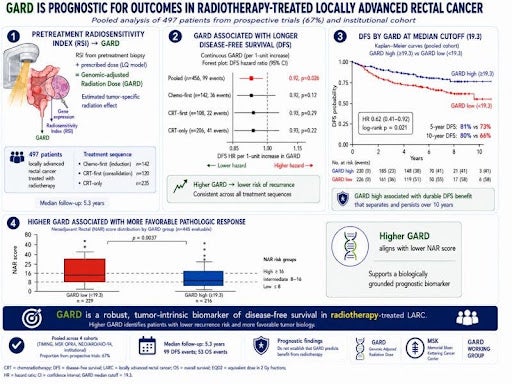
Published as a preprint on medRxiv, the study evaluated the Genomic Adjusted Radiation Dose (GARD) in 497 patients across four contemporary cohorts, including 335 patients enrolled in prospective clinical trials. The cohorts represented several modern treatment approaches, including induction chemotherapy followed by chemoradiotherapy, chemoradiotherapy followed by consolidation chemotherapy, and chemoradiotherapy alone.
The analysis found that higher continuous GARD was associated with longer disease-free survival. Each one-unit increase in GARD was associated with an 8% reduction in the hazard of disease recurrence or death (HR 0.92; p=0.026). At the median GARD cutoff, five-year disease-free survival was 81% versus 73%, while 10-year disease-free survival was 78% versus 66%. Higher GARD was also associated with a more favorable Neoadjuvant Rectal score, suggesting a relationship between predicted biological radiation effect and treatment response.
The findings point to a fundamental question in radiation oncology: although patients may receive similar physical radiation doses, their tumors can experience different biological effects. GARD could ultimately help researchers investigate whether radiation treatment can be better tailored to an individual tumor’s biology.
“Perhaps physical dose alone is not the quantity we should ultimately be prescribing,” says Scott. “Can we use tumor biology to identify who needs more radiation, who needs less, and what biological effect we should actually be aiming for?”
The study was led by Drew T. Bergman, MD, a radiation oncology resident at Memorial Sloan Kettering Cancer Center, and Paul B. Romesser, MD, a physician-scientist instructor in radiation oncology at Memorial Sloan Kettering. Researchers from Cleveland Clinic Research, a Case CCC consortium member, and Moffitt Cancer Center also contributed to the study, including Javier F. Torres-Roca, MD.
The team is now seeking additional datasets to independently evaluate these findings and is building a GARD Working Group focused on radiation genomics, RSI/GARD, and precision radiation oncology.