
A Theory of Trust in Institutions

Tuesday, April 14th, 2026
4:30 PM - 5:30 PM

Add to Calendar: Add to Calendar: 2026-04-14 16:30:00 2026-04-14 17:30:00 A Theory of Trust in Institutions Event Description In this talk, I offer a way to think about institutional trust. We routinely rely on institutions such as courts, agencies, universities, and the press, yet we cannot verify, on a case-by-case basis, the quality of their outputs. Institutions manage this problem by adopting a mandate, meaning a publicly understood role that lets outsiders form reasonable expectations without auditing every decision. However, trust in a mandate does more than reassure the public that institutional insiders are doing their jobs. It also turns the institution into a platform that amplifies whatever insiders do. That amplification creates pressure to use the institution for adjacent, non-mandated objectives. As influence grows, that pressure can pull activity beyond the mandate and erode trust. The lecture develops this mechanism, which I call elite drift, explains why simply trying harder at the core mission is often an unstable fix, and draws out what the framework implies for institutional design questions that lawyers care about, including independence and accountability, and how spillovers in trust can arise across peer institutions. Attorneys will benefit from this lecture by gaining a sharper framework for diagnosing institutional failure, anticipating trust-related vulnerabilities, and advising clients or organizations on how to maintain legitimacy in complex governance environments. About the Speaker Sarath Sanga is a professor of law and co-director of the Center for the Study of Corporate Law at Yale Law School. He teaches contracts and corporate law, as well as a law and economics course at Yale College. Prior to joining Yale, he held permanent and visiting positions at Harvard, Stanford, Northwestern, the University of Chicago, Columbia, and the University of California, Berkeley. Sanga specializes in contracts and governance: how people and organizations structure their relationships and set their own rules. His research has explored how shareholder agreements are reshaping corporate governance, demonstrating how the subtle design of corporate altering rules can fundamentally shift power and control of corporations. He also investigated the logic behind venture-capital contracts, showing how these documents solve (or exacerbate) complex fiduciary conflicts in startups. Another strand of his research examines how firms select governing laws for their contracts and their corporations, and why some states — like Delaware and New York — dominate the landscape through powerful network effects. His work also addresses how contracts strategically omit terms to achieve outcomes that explicit terms can't. For example, companies craft intentionally incomplete employment agreements to enforce noncompete clauses precisely where the law forbids them. He proposed fresh regulatory strategies to rebalance state, federal, and individual interests in arbitration. His research also examines broader legal institutions: revealing the troubling rise in domestic violence during COVID-19 lockdowns, how police treat motorists, how officer race affects policing outcomes, and the impact of affirmative action bans. He has also studied the legal profession itself, including how occupational licensing rules reduce labor market mobility among lawyers and the rise of women in law schools. He co-founded SCALES, a project harnessing AI and natural language processing to make federal court records freely accessible, whose mission is to combat the legal system’s costly and senseless barriers to public access to court records. Download the reading materials. George Gund Hall CWRU School of Law Moot Courtroom 11075 East Blvd. Cleveland, OH 44106 School of Law School of Law America/New_York public

1.0 hour of CLE credit has been approved

Event Description

In this talk, I offer a way to think about institutional trust. We routinely rely on institutions such as courts, agencies, universities, and the press, yet we cannot verify, on a case-by-case basis, the quality of their outputs. Institutions manage this problem by adopting a mandate, meaning a publicly understood role that lets outsiders form reasonable expectations without auditing every decision. However, trust in a mandate does more than reassure the public that institutional insiders are doing their jobs. It also turns the institution into a platform that amplifies whatever insiders do. That amplification creates pressure to use the institution for adjacent, non-mandated objectives. As influence grows, that pressure can pull activity beyond the mandate and erode trust. The lecture develops this mechanism, which I call elite drift, explains why simply trying harder at the core mission is often an unstable fix, and draws out what the framework implies for institutional design questions that lawyers care about, including independence and accountability, and how spillovers in trust can arise across peer institutions. Attorneys will benefit from this lecture by gaining a sharper framework for diagnosing institutional failure, anticipating trust-related vulnerabilities, and advising clients or organizations on how to maintain legitimacy in complex governance environments.

About the Speaker

Sarath Sanga is a professor of law and co-director of the Center for the Study of Corporate Law at Yale Law School. He teaches contracts and corporate law, as well as a law and economics course at Yale College. Prior to joining Yale, he held permanent and visiting positions at Harvard, Stanford, Northwestern, the University of Chicago, Columbia, and the University of California, Berkeley.

Sanga specializes in contracts and governance: how people and organizations structure their relationships and set their own rules. His research has explored how shareholder agreements are reshaping corporate governance, demonstrating how the subtle design of corporate altering rules can fundamentally shift power and control of corporations. He also investigated the logic behind venture-capital contracts, showing how these documents solve (or exacerbate) complex fiduciary conflicts in startups. Another strand of his research examines how firms select governing laws for their contracts and their corporations, and why some states — like Delaware and New York — dominate the landscape through powerful network effects.

His work also addresses how contracts strategically omit terms to achieve outcomes that explicit terms can't. For example, companies craft intentionally incomplete employment agreements to enforce noncompete clauses precisely where the law forbids them. He proposed fresh regulatory strategies to rebalance state, federal, and individual interests in arbitration.

His research also examines broader legal institutions: revealing the troubling rise in domestic violence during COVID-19 lockdowns, how police treat motorists, how officer race affects policing outcomes, and the impact of affirmative action bans. He has also studied the legal profession itself, including how occupational licensing rules reduce labor market mobility among lawyers and the rise of women in law schools.

He co-founded SCALES, a project harnessing AI and natural language processing to make federal court records freely accessible, whose mission is to combat the legal system’s costly and senseless barriers to public access to court records.

Download the reading materials.

Event Location

George Gund Hall
CWRU School of Law Moot Courtroom
11075 East Blvd.
Cleveland, OH 44106
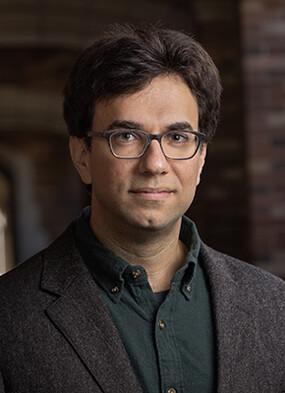
Sarath Sanga headshot
Sarath Sanga, Professor of Law and Co-Director, Yale Law School Center for the Study of Corporate Law